



A lot of businesses do not have a marketing problem in the dramatic sense. They have a quiet one. The website is live. The ads are running. The social posts appear on schedule. And yet the enquiries are thinner than they should be, or thinner than they used to be, or just never quite enough to make the effort feel worth it.
That kind of gap is usually not caused by one huge mistake. It is usually caused by a few small ones that never get connected.
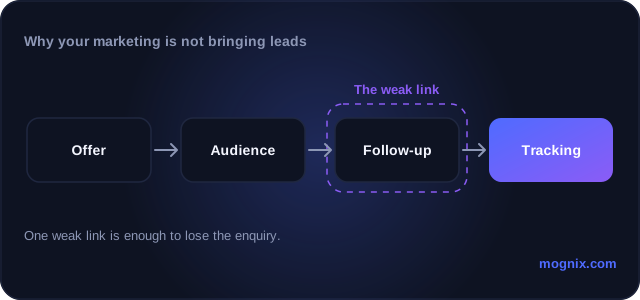
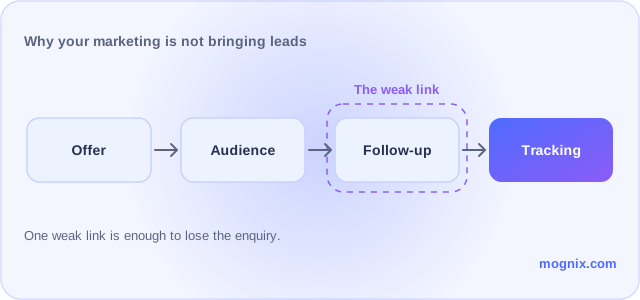
Marketing not bringing leads: the first is a weak next step
Marketing can do a lot, but it cannot force a person to act. If every campaign leads to a vague page, a form that feels like work, or a message that does not make the next step obvious, the effort leaks out at the end. This is one of the most common reasons marketing looks busy without producing much. The top of the funnel works. The part that turns attention into action does not.
The second is unclear targeting
Some campaigns spread themselves too wide. They reach more people, but not the right people. Others reach the right people but with a message that does not fit them. Either way, the result can look like low-quality leads, wasted budget, or both. If you cannot say who the campaign is for, it is usually hard to tell whether it is working.
The third is inconsistent follow-up
A lead that is captured and then ignored is a lead that goes cold. That sounds obvious, but it happens constantly. Someone fills in a form, sends an enquiry, or clicks a call-to-action, and then the business waits too long, replies too vaguely, or replies in a way that does not move things forward. Marketing brings the person to the door. The follow-up decides whether they come in.
The fourth is not knowing what success actually is
If the goal is “more marketing” rather than “more of the right enquiries,” it becomes hard to tell good efforts from bad ones. Likes, clicks, impressions, and even leads can all be useful to watch. None of them is the same thing as progress. A business that wants better results usually needs to pick the outcome it cares about and use that as the reference point. Google’s guide to conversion measurement explains how that outcome gets tracked back to the campaign that produced it.
The fifth is trying to fix everything at once
When results are disappointing, the instinct is often to do more. More posts. More ads. More channels. More content. But if the problem is the offer, the message, the form, the audience, or the follow-up, adding more activity usually just adds more noise. The businesses that improve fastest are usually the ones that find the weakest link and strengthen it first.
A practical way to think about it is this: if people are arriving but not acting, the problem is probably near the action. If people are not arriving at all, the problem is probably near the reach. If people arrive and act but do not convert, the problem is probably near the offer or the follow-up. That simple split is often enough to point at the right fix.
Marketing should not be judged by how active it looks. It should be judged by whether the right people are showing up, and whether they are doing the thing the business actually wants them to do.
If your marketing is not bringing in enough leads, the issue is usually not that everything needs more effort. It is usually that one part of the chain needs to be tightened. If you want a second opinion on where yours is leaking, see how Mognix works with businesses on SEO and paid campaigns, read our guide to local SEO for Kolkata businesses, or request a free audit.