



Ask how much to spend on Meta ads and most answers are useless, because they skip the two things that matter: what a lead is worth to your business, and how much data the platform needs before it can work. A Meta ads budget is not a number you copy from someone else’s account. It is an outcome you work backwards from.
There is no universal number, but there is a floor
Anyone who quotes a single monthly figure without knowing your margins is guessing. What is true for almost every account is that there is a minimum spend below which results stay random. Under that floor, the algorithm never gathers enough of the right signals, so you are paying to learn nothing.
The floor is not the same for everyone. It depends on your location, your audience size and how competitive your category is, so the honest answer is to test your way to it rather than assume it.
Start from the value of a lead, not from the spend
Before you choose a number, answer two questions. What is one customer worth to you over a year? And roughly what share of enquiries turn into customers? If a customer is worth ₹60,000 and one in ten enquiries becomes a customer, then an enquiry is worth about ₹6,000 to you. That single figure decides whether a ₹300 or a ₹900 cost per lead is cheap or ruinous.
Most businesses set a budget first and only later ask what a lead is worth. That order is why so many campaigns feel like a gamble
Meta explains how ad delivery and pricing work across its placements in the Meta ads overview, which is worth reading before you commit to a number.
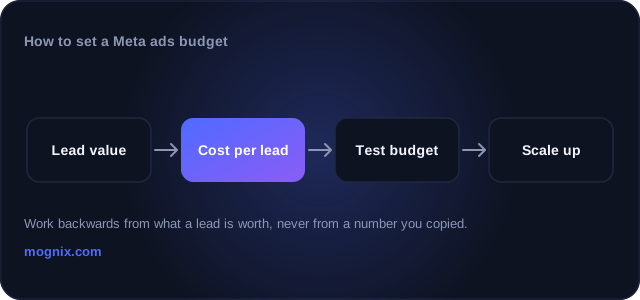
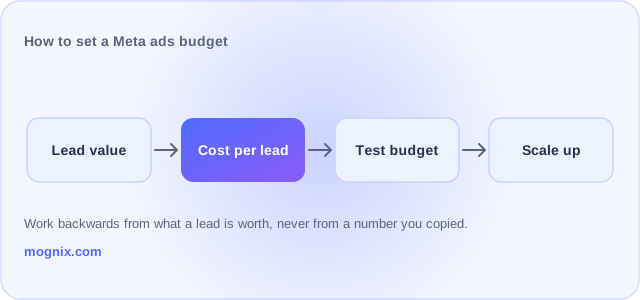
How to set a Meta ads budget in four steps
- Work out your ceiling cost per lead. Take the value of a customer, multiply by your close rate, and divide by the profit margin you are willing to spend on acquisition. That is the most you can afford per enquiry.
- Set a testing budget. Enough to generate a few dozen leads, not a few. Until you have that volume, cost per lead is noise.
- Run it for a full cycle. Two to four weeks, so weekday and weekend behaviour both appear in the data.
- Decide on evidence. If cost per lead is under your ceiling, increase spend in steps. If it is well above, change the offer or the audience before you change the budget.
Why a very small Meta ads budget usually disappoints
A budget small enough to be spread across a wide audience rarely exits the learning phase properly. The platform keeps testing, delivery stays unstable, and you see a cost per lead that swings wildly week to week. The usual reaction is to cut the budget further, which makes the problem worse.
A smaller budget concentrated on one clear audience and one clear offer almost always beats a larger budget spread thin across five audiences and three objectives.
The testing budget and the scaling budget are different
Treat them as two separate pots. The testing pot exists to find what works and is allowed to lose money in exchange for information. The scaling pot only ever goes to a campaign that has already proven a cost per lead under your ceiling.
Mixing the two is how accounts end up scaling something that was never profitable, simply because it looked fine during a quiet week.
What changes your Meta ads budget the most
- Audience size. A tight audience in one city is smaller than a national one, so the same spend reaches the same people more often and costs more per result as frequency climbs.
- Competition. Seasonal peaks in your category push costs up regardless of how good your account is.
- Creative freshness. The same image for eight weeks gets expensive. New creative is often the cheapest way to lower cost per lead.
- Lead quality, not just lead cost. Cheap leads that never answer are the most expensive budget line in the account.
Signs to spend more, and signs to stop
Spend more when cost per lead is comfortably under your ceiling, the leads are reachable, and the bottleneck is volume rather than quality. Increase in increments and watch cost per lead for a week before the next step.
Stop and fix things when cost per lead is above your ceiling for three weeks running, when you cannot reach the leads you paid for, or when the offer has quietly changed. More budget does not repair a broken offer. It only makes the same mistake larger.
Where to start this month
Pick one audience, one offer and one landing page. Give it a budget that can produce a few dozen leads, not a few. Measure cost per enquiry against the ceiling you calculated, then let that number decide the next move rather than your comfort level.
If you want a second opinion before you commit spend, see how Mognix manages Meta Ads, read the fixes that matter most in our guide to Meta ads that bring enquiries, or request a free audit and we will tell you what we would change first.
Trackbacks/Pingbacks