
Most local businesses already have a Google Business Profile. Very few are using it. The listing exists because Google built one from a directory entry years ago, somebody claimed it, added a phone number, and then closed the tab. Meanwhile the competitor two streets away appears in the map pack for the searches that matter, with photos from this month, forty reviews, and a questions section that looks like someone is paying attention.


That gap is not a technical one. It is a series of small maintenance decisions, and for a local business that does not want to pay for every click, it is the highest-return work available. No other channel puts a business in front of someone who is already looking, at the exact moment they are looking, for free.
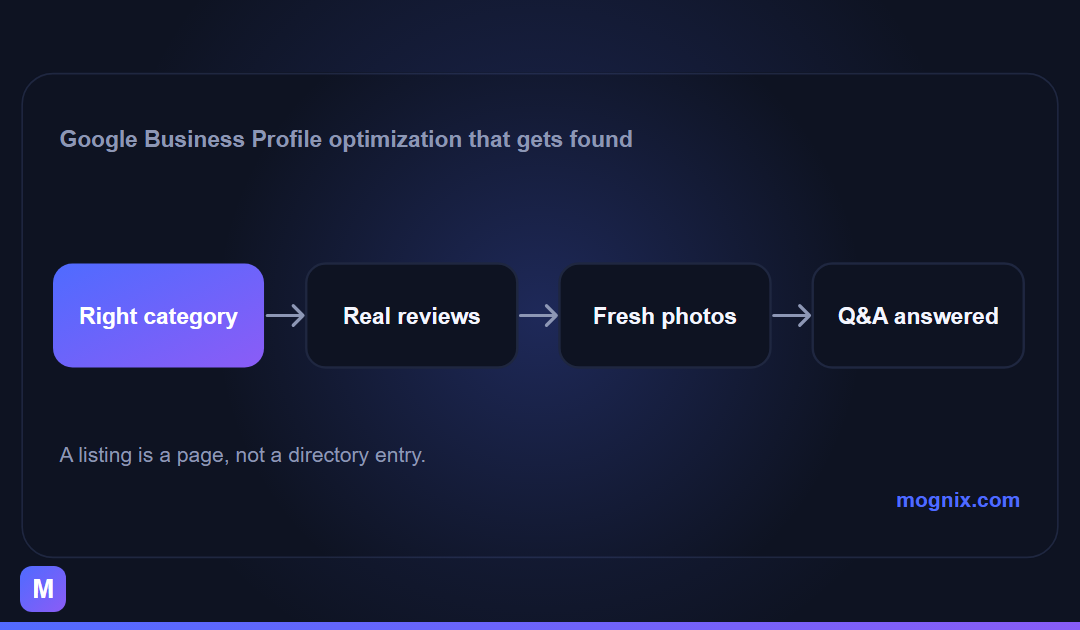
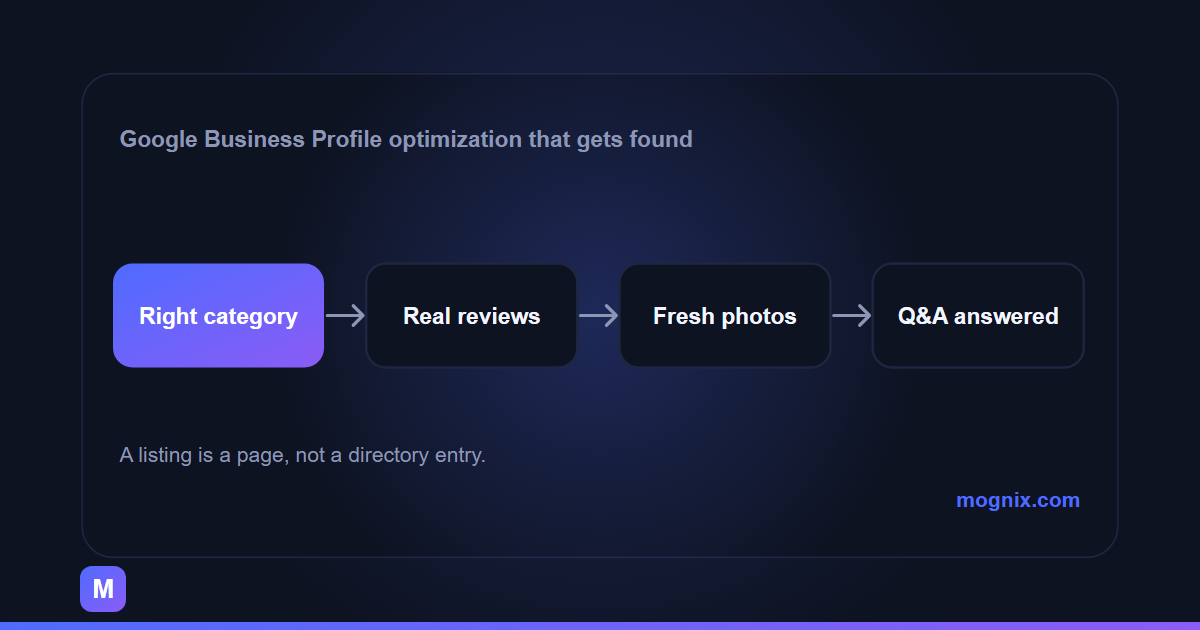
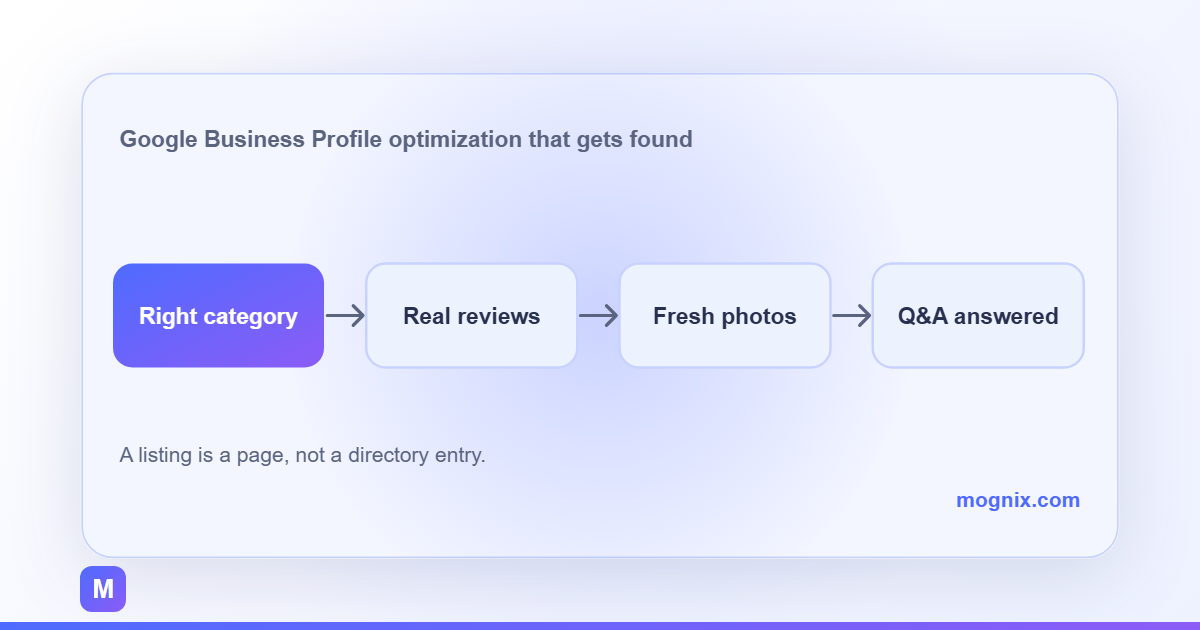
Google Business Profile optimization is mostly a decision about categories
The category you choose is the strongest signal you control, and most businesses get it wrong in the same direction: they pick something broad because it feels safer. “Marketing agency” is broader than “Internet marketing service”, and the broader term competes with far more listings for far less targeted searches.
Pick the primary category by search behaviour, not by pride
Ask what a customer types when they are ready to buy, then find the closest category to that phrase. A Kolkata interior contractor who selects “Interior designer” will be shown for design searches; one who selects “Contractor” will be shown for building searches. Both are honest descriptions. Only one matches the moment someone decides to enquire.
Google publishes its own guidelines for representing your business, and the relevant line is simple: describe the business as it actually operates, not as you would like it to be described. Beyond the primary category you can add secondary categories, and they are worth using carefully. Two or three accurate ones widen the surface area. Ten speculative ones dilute it.
Fill in services, not just the description
The description field is where businesses write three paragraphs about their values. It is the least-read part of the listing. The services list, on the other hand, is structured, searchable and directly matched against queries. If a business offers “emergency plumbing”, “bathroom fitting” and “leak detection”, each one belongs in the services list as its own entry, not buried in a sentence.
The same goes for attributes. “Online appointments”, “Wheelchair accessible entrance”, “Free estimates” are filters customers actually apply. Leaving them blank removes the listing from those searches entirely, and there is no way to recover the impression you never got.
Make the name, address and phone number identical everywhere
Google cross-references the listing against the rest of the web. If the site footer says one number, the Facebook page says another, and a directory entry from 2019 has a third, the listing loses a little confidence with each mismatch. Consistency is not a ranking trick, it is a trust signal, and it is invisible when it is right and expensive when it is wrong.
The fix is dull housekeeping: pick one format for the business name (no keyword stuffing, which risks suspension), one phone number, one address, and use them identically on the website, the social profiles, the maps listing and the two or three directories that genuinely get traffic in your city.
Reviews do more work than any single update
Reviews influence the decision of the person reading them and the position of the listing itself. Businesses treat them as a reputation problem when they are a distribution problem: too few people are asked.
Ask at the moment of delivery
The best time to ask for a review is the minute after the work is finished and the customer is happy, not a week later in an email that gets buried. A short link, sent by WhatsApp while you are still on site, converts far better than any follow-up campaign. What kills review volume is not unwillingness, it is friction: a form, a login, a link that expires.
Reply to every review, including the bad ones
A reply is read by every future customer who scans the review count. A calm, specific reply to a one-star review does more for conversion than ten five-star reviews without responses, because it shows how the business behaves when something goes wrong. Reply within a couple of days, name the problem, say what changed. Never argue, and never explain that the customer was mistaken, even when they were.
Watch the review mix, not only the average
A listing with 4.8 from eight reviews is less convincing than 4.5 from ninety. Volume and recency both matter: a steady trickle of reviews this month reads as an active business, whereas forty reviews from 2021 reads as a business that has stopped. If reviews have dried up, that is usually a process failure, not a customer failure.
Photos and posts keep the listing alive
Google’s local ranking documentation is clear that prominence, distance and relevance drive the map pack, and that a complete, active profile performs better than a bare one. Activity is the part most businesses skip.
Upload real photographs on a schedule
Camera-roll photos of the actual premises, the actual team and actual finished work outperform stock imagery, and they update a freshness signal that stock images never touch. Ten photos a month is plenty: the shopfront, the interior, the van, a job in progress, a finished result. Name the files sensibly before uploading so the alt text is not “IMG_2043”.
Use posts for offers, not announcements
The posts feature has a short shelf life, which makes it well suited to concrete, time-bound things: a seasonal offer, a new service, a booking window before a busy period. Company announcements belong on social media, where people follow a business deliberately. A listing that has not posted in nine months looks dormant even if the business is thriving.
Answer the questions section yourself
Anyone can post a question on a listing, and anyone can answer it, including the business. Left alone, the section fills with half-answers from strangers. Seeding it with the three questions the receptionist is asked every week, and answering each in two sentences, converts a confusing corner into a sales page.
What to track so this stops being guesswork
Google shows the numbers: searches that surfaced the listing, calls, direction requests, website clicks, and how those split between discovery and direct searches. Discovery means someone found the business by searching for what it sells. Direct means they already knew the name. The first number is the one that grows when the work above is done properly.
Check the profile every month and do four things: look at discovery searches for a query you do not rank for, add the service or attribute that would cover it, ask the last five customers for a review, and upload this month’s photos. That is the whole routine, and it takes under an hour.
If the listing is already clean and still quiet, the constraint is usually elsewhere: the category is too broad, the service area is wrong, or the website it links to does not convert the visit. Our SEO services cover the local groundwork, our guide to local SEO for Kolkata businesses goes deeper on the map pack, and if you want the listing audited alongside the site it points to, request a free audit.