
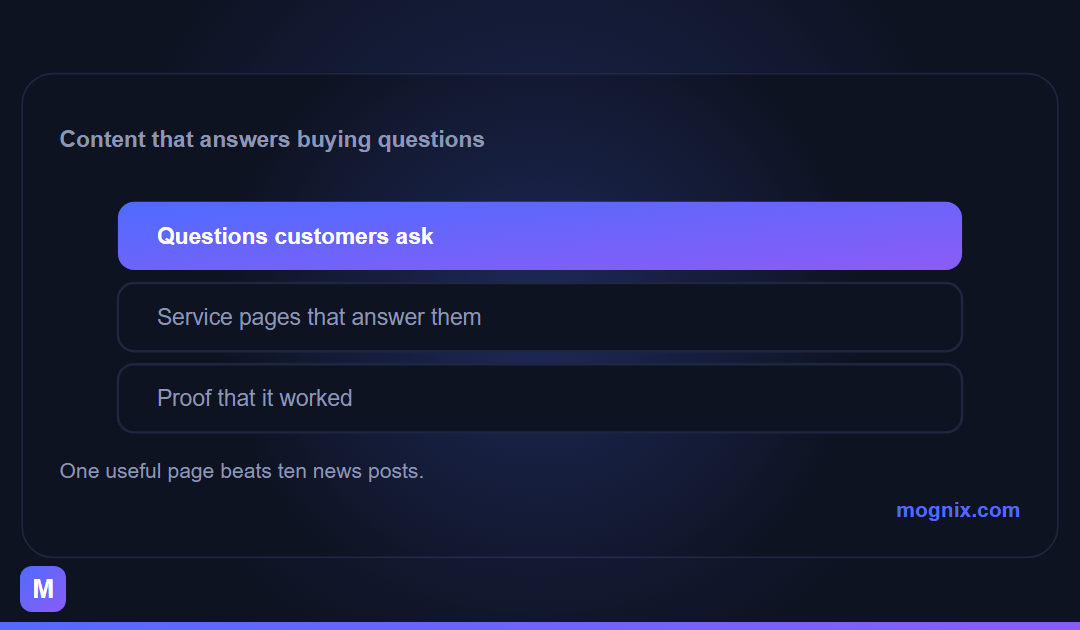
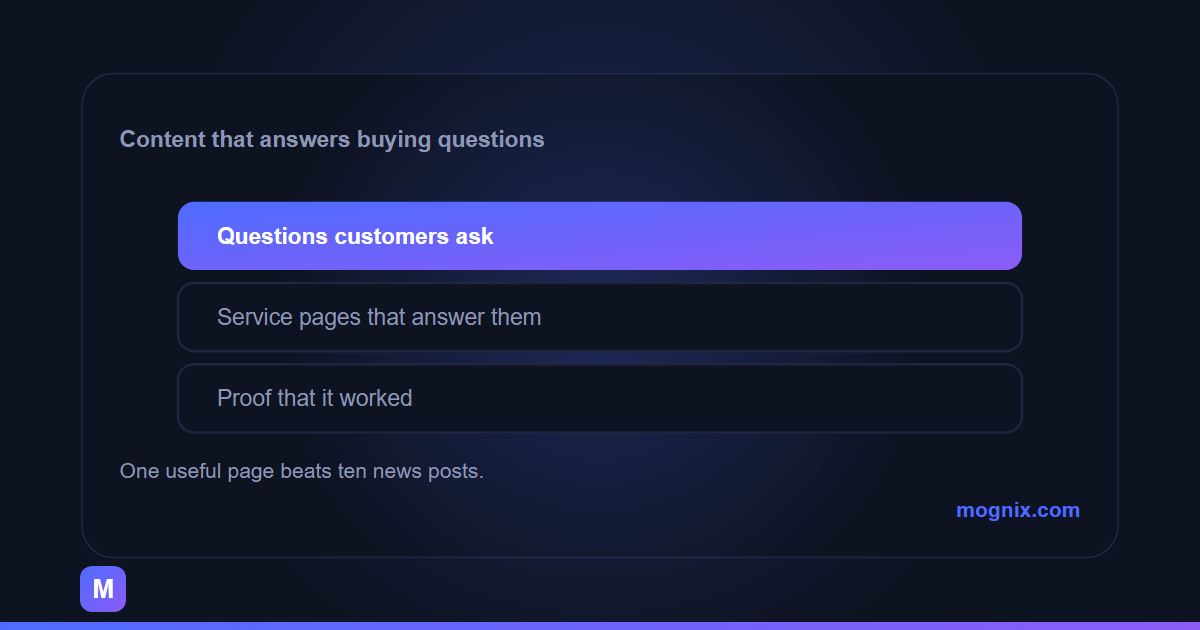
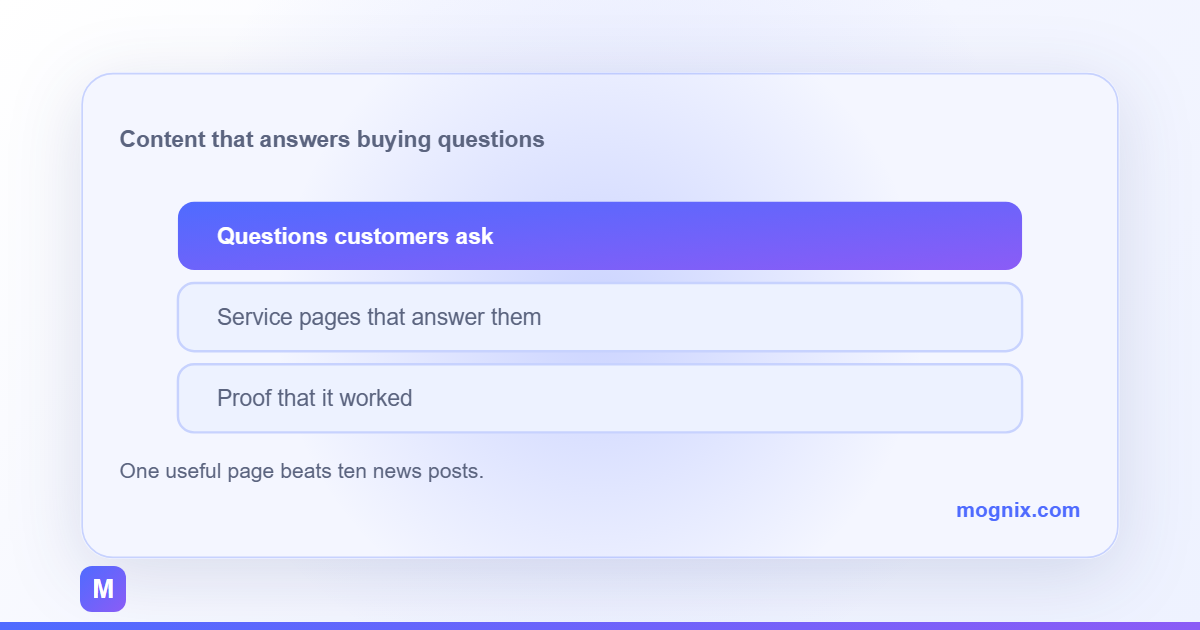
Content marketing for local business is usually copied from a national brand’s playbook: publish three posts a week, build an audience, nurture it. That playbook assumes a content team and a long time horizon. A local service business has neither, and it does not need an audience. It needs a customer with a leaking roof to find the page that explains what the repair involves, what it costs, and who to call.


That is a different job, and it produces a different kind of content. Fewer pages, each tied to a service and a question, each with a route to an enquiry. The measure is not traffic or time on page; it is whether the page brings someone closer to booking. A hundred visits that end in three calls beat ten thousand visits that end in a newsletter subscription nobody reads.
Start with the questions the business already answers
The best content brief is the phone log. Write down every question the receptionist, the sales team and the owner answered this week. Group them: price, process, timing, suitability, guarantee, location. Those groups are the editorial calendar, and they are better than any keyword tool because they come with real language and real intent.
The five question types worth a page
Price questions (“how much does a bathroom refit cost in Kolkata”) are the highest-intent searches and the ones most businesses avoid. Answer with a range, the factors that move it, and an invitation to get an exact quote. The range does not commit the business; it filters out people who cannot afford the work.
Process questions (“what happens during a CCTV drain survey”) reduce fear. Timing questions (“how long does a boiler installation take”) set expectations. Suitability questions (“do I need planning permission for a shopfront”) establish expertise. Guarantee questions (“what does your warranty cover”) remove the final objection.
Turn the answers into pages, not posts
A blog post is dated; a service page is permanent. Content marketing for local business earns more from that placement than from a separate blog archive, so most of these answers belong on or beside the service page, because that is where the buyer already is. Add an FAQ section, a cost table, a “what to expect” timeline. A separate article is right when the question is big enough to deserve its own search result, or when it serves a different audience.
This distinction keeps the site from accumulating fifty thin posts that compete with each other. One strong page per service, with the questions answered on it, is a better use of the same effort. Google’s guidance on creating helpful content points the same way: write for a person with a problem, not for a search engine with a quota.
The local angle is the advantage
A national site cannot tell a reader which streets flood first in their neighbourhood or which council office handles a particular permit. A local business can, and that specificity is what makes the content worth reading and worth linking to.
Details only a local operator knows
Name the areas served, the typical property types, the local suppliers, the seasonal problems, the parking situation, the approval process. A page about “damp proofing in old Salt Lake buildings” is more useful than “damp proofing: a complete guide”, and it is far easier to rank because the competition is thinner.
Photograph the actual work. A before-and-after from a local street is content that no competitor can copy, and it doubles as proof. Ask permission before publishing a customer’s home, and keep the address out of the caption.
Local links follow local content
The organisations that might link to a local business need a reason. A guide to preparing a heritage building for monsoon, a checklist for shopfront permits, a survey of local commercial rents: each is something a chamber of commerce, a local paper or a supplier can reference. That is how content and links reinforce each other, without a link-building campaign.
The content does not have to be long. A single page with a table, three photos and a clear answer can earn a link that a thousand-word opinion piece never will.
Content marketing for local business needs a small plan
The failure mode is a burst of six posts in January and silence by March. Content marketing for local business only compounds when the plan survives the first busy month, so a plan that survives is small enough to keep: one substantial page a month, plus the service-page improvements that take an afternoon.
A quarter of work, not a year
Pick the three services that produce the most revenue. For each, write one page that answers the buying question with the most search demand. Then improve the service page itself: add the FAQ, the price range, the process, the proof. That is six pieces of work for a quarter, and it is achievable.
If there is capacity for more, add one article a month that targets a question one step earlier in the decision. Link it to the service page. Do not publish an article without a destination; content that does not lead anywhere is a hobby.
One owner and a review date
Assign the work to one person, even if that person is the owner writing on a Sunday. Set a review date three months out. At the review, look at Search Console impressions, enquiries from the page, and the questions the sales team is still hearing. Keep what worked, rewrite what did not, delete what nobody reads.
Deleting is part of the plan. A page that gets no impressions and no links after a year is clutter, and merging it into a stronger page usually helps both.
Measure the pages that produce enquiries
Content marketing for local business is judged on enquiries, not sessions. Use the analytics key event from the enquiry form, and add a question to the booking process: “Which page did you read before calling?” Most customers will not remember, but enough will to show a pattern.
Track three things per page: impressions in Search Console, enquiries attributed to the page, and links earned. A page with rising impressions and flat enquiries needs a stronger call to action. A page with enquiries and no impressions is doing its job through the sales team and email, which is fine. A page with neither after six months should be rewritten or removed.
Content marketing for local business is judged on the same three numbers every quarter, so the review never needs a new spreadsheet.
Do not judge a page in the first month. Local search results move slowly, and a new page can take three months to settle. Judge the plan quarterly, not weekly.
The short version
If the rest of this is too much to hold at once, content marketing for local business comes down to five lines:
Collect the questions from the phone log, the sales team and Search Console; they are the brief, and they are free.
One page per buying question, on the site, permanent, with a price range, a process and proof on it.
Local detail nobody else can write: the streets, the suppliers, the approvals, the photographs from real jobs.
One substantial page a month, reusing each answer across the profile, the email and WhatsApp on the way out.
Measured on enquiries, reviewed quarterly, rewritten or removed after a year of silence.
That is the whole strategy. Content marketing for local business is not a channel to master; it is a habit of answering the questions the business already hears, in a place the business already owns.
What good looks like after a year
After a year, content marketing for local business produces twelve to twenty pages that each answer a real buying question, a service page for every service sold, a handful of local guides that earn links, and a clear route from every page to an enquiry. That is a content programme for a local business. It will not produce a viral post, and it does not need to.
The pages keep working while the business does, and the questions in the sales log keep feeding the next batch. The compounding is slow and real, which is the opposite of most marketing that a small business is sold.
Turn one good answer into five pieces of content
Content marketing for local business gets expensive when every channel is treated as a separate job. It is not one. A single well-answered question, the kind the receptionist heard three times this week, becomes a service-page section, a Google Business Profile update, a paragraph in the monthly email, a short WhatsApp broadcast and a caption for the photograph you took on site. The expensive part was never the writing. It was deciding what to write five times.
Work from the page outwards. Write the full answer once, on the site, where it can rank and where it stays. Then cut it down for each channel rather than starting again:
The page carries the complete answer, with the price range, the process and the proof.
The profile post carries the first two sentences and the photograph, and points at the page.
The email carries one question, one short answer and one link, for the list you already own.
The WhatsApp broadcast carries the same answer in two lines, sent only to the people who asked about that service.
The social post carries the before-and-after image with the local detail in the caption.
Five touches, one afternoon of thinking. This is also how content marketing for local business survives a slow month: the queue of questions is the queue of channels, and every answer already written can travel further.
One rule keeps it honest. Never publish the same sentence in two places on the site itself, because two near-identical pages compete with each other and neither ranks. The discipline of content marketing for local business is choosing one home for each answer; repetition belongs to the channels you do not own, never to the pages you do.
When the competitor publishes more
A national publisher with a content team will always outproduce a two-person business, so competing on volume is the wrong contest. Content marketing for local business wins on specificity, and specificity is free.
Start with the phrasing the big sites cannot use. A national page has to write for every city at once; it cannot say which streets flood first, which buildings need a particular approval, which suppliers are two miles away, or what a job costs in this market. Every one of those details is a search you can own and they cannot. Where to look: the questions in your own sales log, the “people also ask” box on your own service searches, and the replies you get when you ask a customer what they searched for before calling.
This is where content marketing for local business earns its keep, because the same page that loses a broad search wins three narrow ones.
Then look at the actual result page before assuming you cannot win. For a long, specific question the first page is often forum threads, old supplier pages and a council PDF, not a polished national article. That is a page you can beat with something current, written by someone who has done the job, with a photograph from a real site. For a short, competitive phrase you will lose, and you should stop spending on it: the same effort applied to three longer questions brings enquiries while the broad phrase is still ranking the same five domains it ranked last year.
Freshness is the other advantage, and it is the one content marketing for local business can repeat every year. Local results reward pages that are visibly maintained, and a national guide from 2021 does not know about this year’s permit changes. Refreshing your own page twice a year, with a date and a note about what changed, costs an afternoon and is more useful than publishing four new thin posts.
The first 30 days of content marketing for local business
If none of this has been done yet, content marketing for local business looks like a mountain. It is four weeks of ordinary work:
Week one: collect. Write down every question the business answered by phone, email and WhatsApp. Ask the sales team for the ones they hear most. Open Search Console and note which queries already show the site, and which page they land on. This is the brief; nothing is published yet.
Week two: choose three. In any plan for content marketing for local business the choice matters more than the count, so pick the three questions with the most revenue behind them and the least competition in the results. For each, decide whether the answer belongs on an existing service page or deserves its own URL. Write the first one fully: price range, process, timing, proof, and a clear route to an enquiry.
Week three: publish and connect. Put the page live, link to it from the service page and from the navigation, add it to the profile as a post, and send it to the list. One page, fully connected, is worth more than three pages nobody can reach.
Week four: repeat and measure. Write the second page. Check impressions for the first. Ask the team whether anyone mentioned it. Then set the rhythm you can actually keep, which for most local businesses is one substantial page a month rather than four posts a week.
Keep the 30 days visible. Put the three chosen questions on a single sheet above the desk with the owner’s name beside each one, and move each to the done column only when the page is live, linked and shared. Content marketing for local business drifts when the plan lives in a document nobody opens; it survives when it lives where the work happens.
The point of the 30 days is not output. It is proving the habit fits inside the working week, because the failure mode of content marketing for local business is a brilliant January and an empty February.
Common questions
How often should a local business publish?
In content marketing for local business, once a month done properly beats four shallow posts. A single page that answers a buying question keeps working for years, while a schedule you cannot maintain stops altogether and teaches the search engines that the site has gone quiet. Content marketing for local business rewards the pages that stay up, not the weeks that stayed busy.
How long before content marketing for local business brings enquiries?
Plan for three months of content marketing for local business before impressions move, and six before enquiries are obvious. Local results settle slowly, and judging a page in its first month tells you nothing except that you looked too early.
Should I write it myself or hire a writer?
Start by writing it yourself. Nobody knows the prices, the process and the local details better, and the first four pages are mostly listening. Hire a writer once the pattern is established and the job becomes transcription: you supply the answers and the photographs, they supply the structure. What you cannot outsource is the judgement about which question to answer next, and that judgement is most of what content marketing for local business is.
Is social media a replacement for content marketing for local business?
No, because you do not own the audience. Social is where the work of content marketing for local business gets distributed; the site is where it accumulates. A page you own still brings enquiries when a platform changes its algorithm or the account is locked out.
What if the keyword I want is dominated by big sites?
Take the long version of the question and answer it better than anyone: the specific service, the specific area, the specific cost. Content marketing for local business is not trying to outrank the national guide on the broad term; it is trying to be the only page that answers the narrow one.
Our SEO services build the content plan around the services that already sell, and the guide to choosing an SEO agency in Kolkata covers what to ask before signing. If you want the current pages sorted into keep, rewrite and remove, request a free audit and we will send back the list with reasons.