
Google Ads Quality Score is the number most accounts are managed against and the one most often misread. It is reported on a 1 to 10 scale, it appears next to every keyword, and it is easy to treat as a school mark that should be improved for its own sake. It is not that. It is a diagnostic that explains why one advertiser pays less than another for the same position, and it is useful only when it points at a specific thing to change.


The number is also a snapshot. Google recalculates it from recent auction data, and it is reported for search campaigns on the search network. A low score on a keyword that barely receives impressions tells you almost nothing, because there is not enough history to score. The first task is therefore to work out which keywords have enough data to deserve attention.
What Google Ads Quality Score actually measures
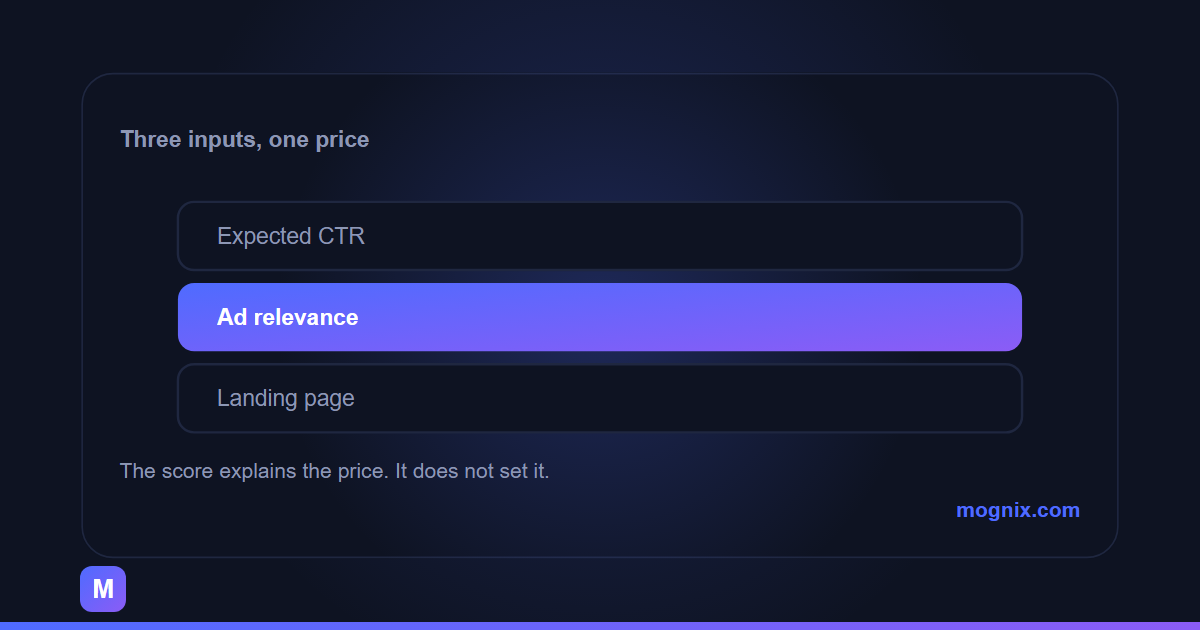
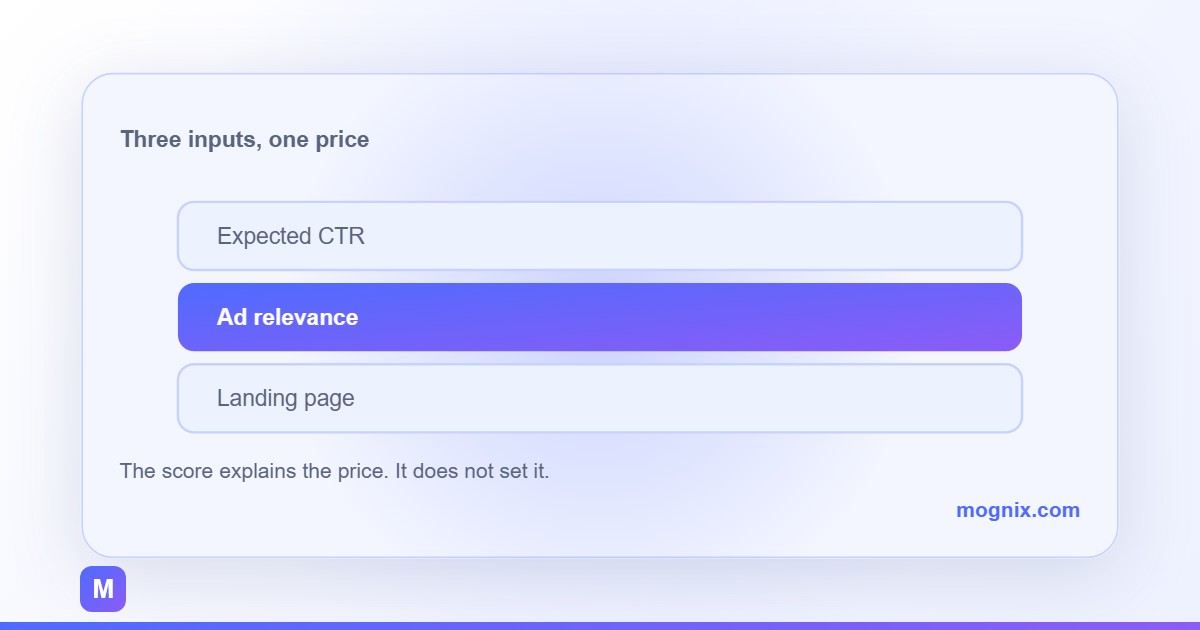
Three components feed the score: expected click-through rate, ad relevance and landing page experience. Each is rated Above average, Average or Below average against other advertisers bidding for the same keyword, not against a fixed standard. That comparison is why a score of 7 in one account can be better than a 9 in another, and why chasing a 10 is usually a waste of a quarter.
Expected click-through rate
This is the component advertisers most want to control, and the one they can influence least directly. It estimates how likely an ad is to be clicked when it appears for the keyword, based on historical performance and the position it appeared in. Moving from position four to position one historically will not lift the estimate, because the estimate is already adjusted for where the ad showed.
What does move it is message match. A keyword about emergency plumbing deserves an ad that says emergency plumbing, not “quality services since 1998”. Two or three ads per ad group, each written for the phrase, will do more for expected click-through than any bid change, because the ad is finally answering the query the person typed.
Ad relevance
Ad relevance asks whether the ad and the keyword are about the same thing. It is the cheapest component to fix: split a broad ad group into two or three tighter ones, then write an ad for each. A single ad group holding twenty keywords about different services will always score poorly here, no matter how good the copy is, because no single ad can be about twenty things.
The fix has a cost: more ad groups mean more management and less data per ad group. For a local business running a handful of campaigns, that cost is small, and the relevance gain is usually the fastest score improvement available.
Landing page experience
This is where the score stops being an ads problem. Landing page experience considers whether the page is relevant to the query, whether it is easy to navigate, how fast it loads, and whether it feels trustworthy. A page that repeats the keyword but buries the phone number below three carousels is relevant on paper and poor in practice.
The useful test is to click your own ad on a phone, on a normal connection, and count how long it takes to see a way to contact the business. If it is more than a few seconds, the page is the constraint, and no amount of ad copy fixes it.
What the score changes, and what it does not
Quality Score feeds Ad Rank, and Ad Rank decides whether an ad shows at all and where. Google’s own explanation of Quality Score is blunt about the relationship: the score is one input alongside the bid, the ad formats in use and the context of the search.
It changes the price of a position
Two advertisers can hold the same position at different costs per click because the lower-scoring one has to bid more to compensate. That is the entire commercial argument for improving the score: not prestige, but the price of the same click. On a campaign spending a meaningful amount each month, a one-point improvement across the account is often worth more than a week of bid tinkering.
It does not decide profitability
A high score on a keyword that never converts is still a loss. The score says nothing about whether the person who clicked was ready to buy, whether the offer was right, or whether the form worked on the phone they used. Those questions belong to conversion tracking and to the offer, and they matter far more than the number beside the keyword.
This is why accounts optimised only for Quality Score drift toward cheap, broad, informational clicks. The keyword is relevant, the ad matches, the landing page loads, and nobody enquires.
It is not comparable across accounts
Because every component is rated against competitors, the same ad and page can score differently in two markets. A 6 in a crowded category with sophisticated competitors may represent better work than an 8 in a market where nobody writes ads properly. Read the component ratings, not the single number.
Where the score does not apply
There are parts of Google Ads where the keyword-level score means little or nothing. Performance Max, Demand Gen and video campaigns do not report it per keyword, because there are no keywords in the same sense. Shopping campaigns report it on product groups rather than search terms. If most of the budget sits in those formats, the score is not the report to manage from.
For a local business, the usual split is a search campaign for the service terms and a Performance Max or local campaign for the rest. The search campaign is where the score is worth reading, and only for the twenty or thirty phrases that carry the spend.
A short routine that keeps it honest
Once a month, sort keywords by cost, not by score, and look at the top twenty by spend. For each one, note the three component ratings. Where expected click-through rate is below average, rewrite the ad for that phrase. Where relevance is below average, move the keyword to a tighter ad group. Where landing page experience is below average, open the page on a phone and fix the first screen before touching the ads.
Anything outside the top spend can wait. A score of 4 on a keyword that has spent a few hundred rupees this quarter is not a problem worth solving, and treating it as one is how accounts end up with a hundred ad groups and no traffic.
Then leave the score alone for a month. It moves slowly, by design, because it is built from recent history. Checking it weekly and reacting to every wobble produces exactly the churn that keeps it low.
If the ads are performing and the score is the only complaint, the better use of the month is the rest of the funnel: the offer, the landing page speed and the follow-up. Our Google Ads services cover the account work, the SEO services cover the term that should not be paid for at all, and if you want the three components read against your own market, request a free audit and we will send back the keywords that are actually costing you money.