
Table of Contents
1. Why YouTube Ads for Local Businesses Are Worth a Test 2. Choosing the Format Before the Budget 3. Targeting That Buys Intent, Not Age Brackets 4. Creative: The First Five Seconds Do the Work 5. What a Small Monthly Spend Actually Buys 6. Measuring YouTube Ads Without Fooling Yourself 7. The Mistakes That Waste a Starter Budget 8. Where to Start This Month


Why YouTube Ads for Local Businesses Are Worth a Test
YouTube ads for local businesses have a reputation problem. The reputation says video means studios, actors and a budget with a comma in it, and that a plumber in a two-van operation has no business there. That was true when video meant television, and it stopped being true somewhere around the point where every phone shot 4K footage and the ad auction opened to anyone with a card and a Google account.
What changed is not just production cost. It is that YouTube sits inside Google Ads, which means the targeting you already use for search campaigns — a radius around your address, a list of service terms, a remarketing audience of people who visited your site — applies to video too. You are not buying a television slot in a city you cannot serve. You are bidding to put a fifteen-second clip in front of someone inside your area who has recently typed something a customer types.
The reason to consider it at all is the shape of the local buying journey. Most service searches are short and urgent: a broken geyser, a leaking roof, a quote needed before Friday. Search ads harvest those moments well and there is nothing here that replaces them. But there is a second, larger group who are not searching yet — the people who will need the same service in three weeks, or who searched once, compared two options and drifted. Video is how you stay in front of that group without paying for another click. Google publishes the mechanics of the format in its video campaign overview, and the useful part for a small business is near the end: you are charged on views and interactions rather than impressions, which keeps the cost per useful moment low.
There is a practical test that decides whether it fits. Ask whether your service is understandable in fifteen seconds. Roof waterproofing, dental aligners, laptop repair, a bakery’s custom cakes, a driving school — yes. Complex B2B consulting, no. If a stranger can watch a house being painted and understand what you sell, video works. If understanding your offer requires three paragraphs, a search ad does the job better.
One more qualification before the plan. Video is not a traffic source that pays back within a week the way a tightly built search campaign can. It pays back over a quarter, by shortening the time between first contact and the enquiry, and by making the branded search that follows cost less. A business that needs cash next Tuesday should put the money into search first and come back to this when the basics are steady.
Choosing the Format Before the Budget
The single most expensive misunderstanding about YouTube advertising is that the format is one thing. It is several, and the wrong one quietly converts a modest budget into a large bill for views nobody wanted.
In-feed video ads
The in-feed format places a thumbnail in the home feed and beside related videos. Someone chooses to click, which means the audience is self-selected: they watched enough to be interested, and you are charged when that interest is expressed rather than assumed. For a local business this is usually the cheapest way to test whether video content works at all, because a campaign can run for the cost of a few coffees a day and the click-through rate tells you immediately whether the thumbnail and the first line of text are doing their job.
The limitation is reach. In-feed depends on someone browsing YouTube with attention to spare, which is common in the evening and rare during lunchtime mobile scrolling. It is a good first test and a weak primary channel.
Skippable in-stream
Skippable in-stream is the format most people picture: a clip plays before the video someone asked for, with a skip button appearing after five seconds. You pay when a viewer passes thirty seconds, or the whole thing if it is shorter, or interacts with it. That pricing rule is the reason this format rewards short creative and punishes vanity: a thirty-second ad charges you per thirty-second watch, and most people will not give you thirty seconds for a first impression.
For local service businesses, the honest use of skippable in-stream is a fifteen-second spot that makes one point and asks for one action. Anything more elaborate belongs in a later stage, if a later stage ever arrives, and most two-van operations never need one.
The formats to leave alone for now
Non-skippable in-stream, bumper ads bought as a standalone campaign, and masthead placements all exist and all have a place. That place is a business with a brand people already recognise, running a campaign someone will be annoyed to miss. A local business running its first video campaign will get more from ten rands of in-feed attention than from forcing a stranger to watch a clip about drain cleaning. Reach is not the goal here. Being remembered by the right few hundred people is.
When you have in-feed working — measurable clicks, enquiries you can trace — the natural second step is skippable in-stream aimed at a remarketing audience: people who already visited the site or watched part of a video. That audience is small, cheap and warm, and it is covered in more detail in our note on Meta retargeting, because the same principle applies on both platforms.
Targeting That Buys Intent, Not Age Brackets
Google will happily let you define a YouTube audience by age, gender, parental status and a long list of interests. For a business with a service radius of fifteen kilometres, almost none of that is worth a rupee. The useful targeting layers are three, and they are all closer to search than to the old television model.
Custom intent audiences
A custom intent audience is a list of search terms, names of competitors, or URLs, from which Google builds a profile of people likely to want your service. For a pest control company, that might be terms like “cockroach treatment cost”, “pest control near me” and “termite inspection price”, plus the domains of two competitors. You are not guessing who the customer is; you are letting Google find the people who behave like someone with the problem you solve.
This is the strongest single setting in a local video campaign, and it is the one most often left on the shelf because it takes ten minutes to assemble. The research process is identical to the one in our guide to Google Ads keyword research: start from the words customers actually use, add the words competitors rank for, and keep the list tight enough that the profile means something.
Location and radius
Location targeting should be set to presence rather than interest. Presence means the ad shows to people physically in your area; interest means anyone who has ever expressed an interest in that area, including people planning a holiday there. The default has changed over the years and the difference matters: a plumber in one suburb does not want to pay for views from someone three states away who searched the city for a hotel.
Set the radius to the distance you genuinely serve, then add a small buffer for the border cases. If you serve fifteen kilometres, a twenty kilometre radius is generous and a fifty kilometre radius is a donation.
Remarketing lists
The third layer is your own audience: site visitors who did not convert, people who watched half of a previous video, and customer lists you can upload. Video is unusually good at this because a fifteen-second reminder reaches someone who already knows what you do, and the platform charges you only when they watch. A remarketing list of 3,000 people will not last long as a standalone audience, which is why the standard approach is to combine it with a broader layer and let Google optimise.
What to leave switched off
Interest audiences alone, “similar to” audiences built from tiny seeds, and the automatic placements Google suggests when you let a campaign run without guidance. Each of these can find buyers, and each of them, given a small budget, spends more time finding people who look like buyers than people who are one. A million impressions from an audience that will never ring your phone is a worse result than nine hundred views from one that will; the auction does not know the difference unless you tell it, and the only way to tell it is to be specific about who counts.
Creative: The First Five Seconds Do the Work
Most local video ads fail in the first five seconds and the rest of the budget is spent confirming it. The good news is that fixing the opening is cheap: it is a rewrite and a reshot first line, not a new production.
Lead with the problem, not the history
A clip that opens with a logo, an aerial shot of the city and a line about being established in 2009 has told the viewer nothing they came for. The first five seconds should name the problem in the customer’s own vocabulary — the damp patch that keeps coming back, the tooth that aches when the tea is hot, the laptop that will not charge — and imply that a solution is following. The company name can arrive at second twelve. Nobody who needs the second half has left by then, and everyone who did not need it was never going to call.
One idea per ad
A single fifteen-second ad should carry one idea, one proof and one instruction. “We repair water damage” is an idea. “Two hundred jobs in this district” is a proof. “WhatsApp a photo and get a quote today” is an instruction. When a business tries to cover repairs, renovations, inspections and a seasonal discount in the same clip, the viewer retains nothing and the click-through rate halves. If there are four services worth advertising, that is four ads, rotated, each with its own landing page — the same discipline that makes landing pages convert.
Shoot for the small screen
Vertical video wins on mobile reach, and mobile is where nearly all local video views happen. The practical rules are unglamorous and effective: hold the phone steady or use a tripod, film in daylight or use a light, keep the subject’s face in the middle third of the frame and their hands doing the work, and cut every pause. A two-minute shoot can produce four usable fifteen-second edits.
Sound matters more than picture quality. Half of viewers will watch with the sound off, so every ad needs burned-in captions that carry the whole message. The other half will watch with sound on, so record clean audio: a phone on a tripod two metres from the speaker in a quiet room beats a lavalier in a noisy workshop every time. Google’s own video guidance covers the craft side in more depth at Think with Google, and the recurring theme there is worth restating: clarity is the creative strategy.
The thumbnail is half the ad
In-feed placements show a thumbnail before anything else, and the thumbnail is doing the same job a search headline does. Two failure modes are common: a wide shot in which nothing is legible at thumbnail size, and a stock image that looks like an advertisement before it reads as a service. The thumbnails that earn clicks show a person mid-task, cropped tight, with one short overlay line of text that names the service. Test two or three; the click-through rate will tell you in a week what a designer cannot tell you in a month.
What a Small Monthly Spend Actually Buys
Numbers here depend on the city, the trade and the season, so treat the following as shapes rather than quotes. In most Indian cities, in-feed video clicks on a well-targeted local audience land somewhere in the range of a few rupees to a few dozen rupees, and skippable in-stream views cost a few paise per view with a low view-to-visit rate.
The shape that matters is the ratio, not the absolute number. A campaign spending ₹10,000 a month might see several thousand in-feed impressions, a few hundred clicks and, depending on the trade, somewhere between a handful and a couple of dozen enquiries. A search campaign spending the same money in a competitive trade might buy fifteen clicks at ₹600 each and three or four enquiries. The video campaign produces cheaper contact and more of it, but warmth per contact is lower: a search lead is asking to buy now, a video lead mostly is not. Both are useful; they are useful for different reasons, and the mistake is expecting one to behave like the other.
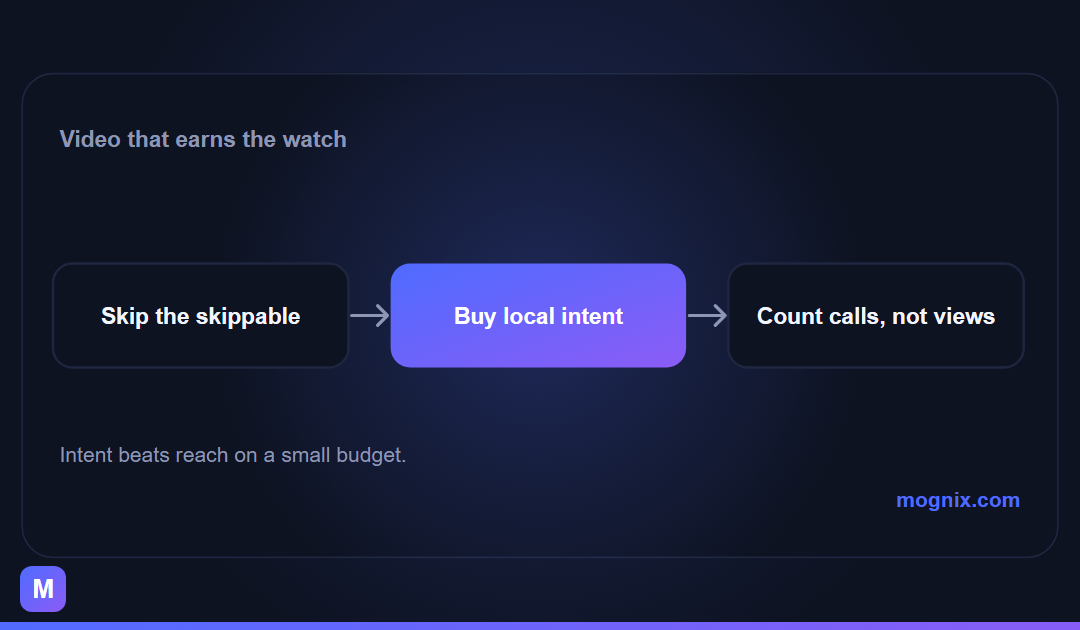
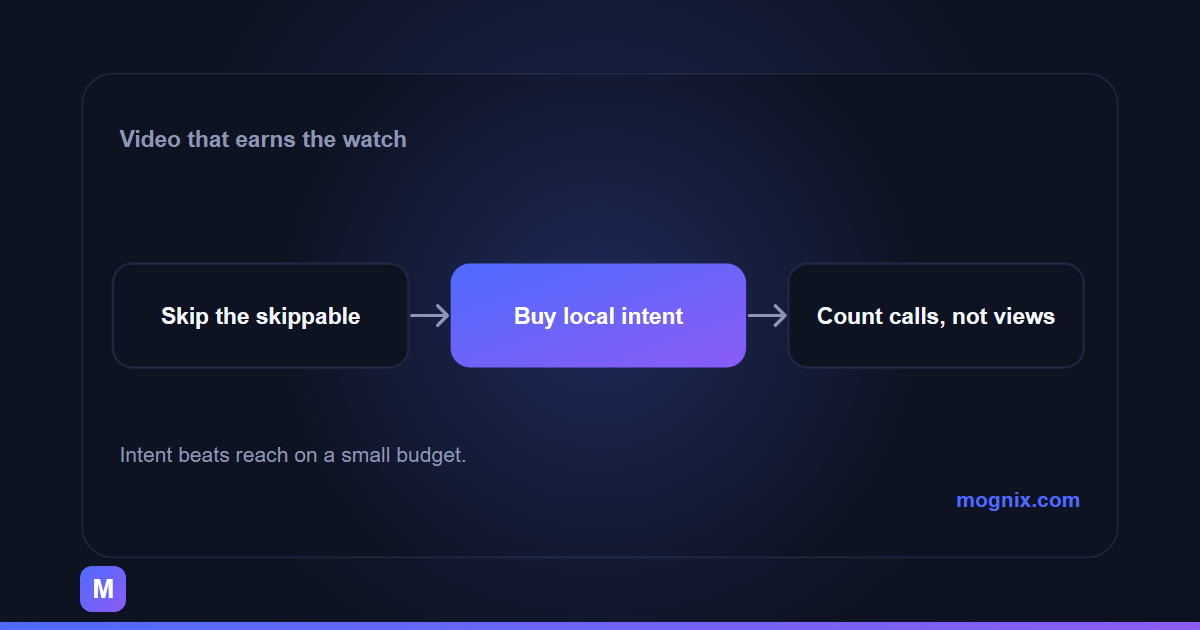
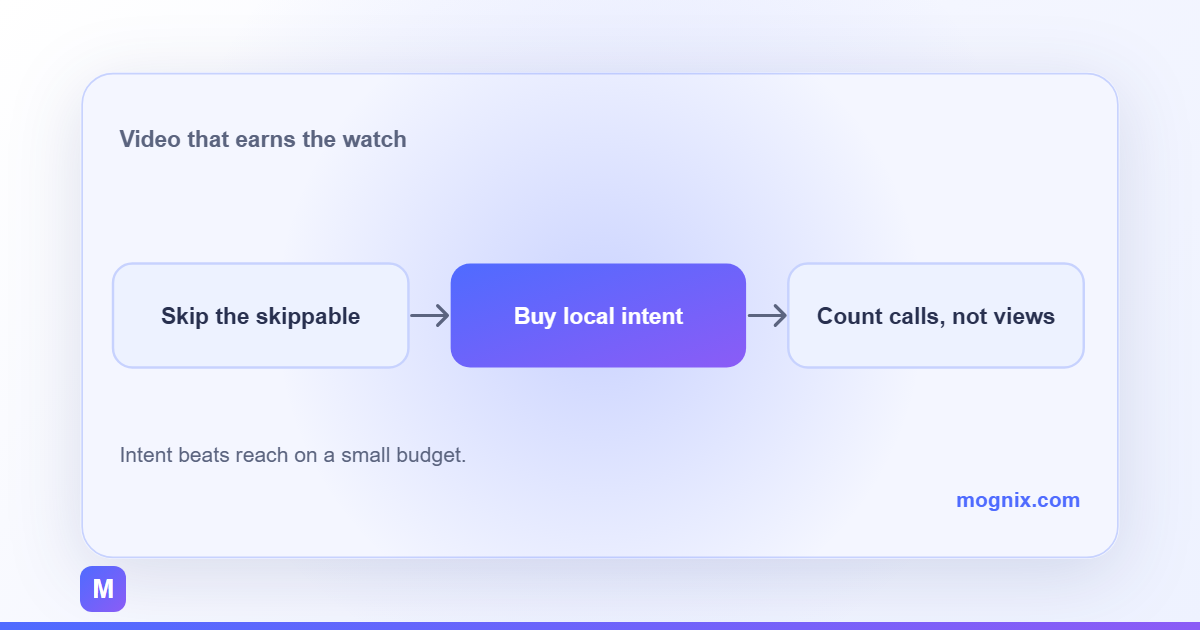
That is why the standard approach for a small business is not to choose, but to sequence. Search campaigns capture the people who are ready, with budgets set by what a lead is worth to the business. Video campaigns cost far less per contact and their job is to be present in the weeks before readiness, and again afterwards for anyone who drifted. The practical split for a first quarter is roughly four parts search to one part video, adjusted for how competitive the search results are — a trade where search clicks cost ₹800 can justify shifting further toward video than one where they cost ₹40.
Two budget mechanics are worth setting on day one. First, a daily budget cap, because video can burn a monthly allowance in a week if the audience is broad and the creative is engaging for the wrong reasons. Second, a frequency cap: showing the same fifteen-second ad four times a day to the same person converts curiosity into irritation. Cap impressions per user per day at two, and rotate in new creative every month or two.
Measuring YouTube Ads Without Fooling Yourself
Video campaigns produce a dashboard full of numbers, and most of them measure attention rather than outcomes. A few measure money, and those are the ones to act on.
The metrics that are worth the row
Cost per view is an input, not a result: it tells you how efficiently the format delivered attention. View-through conversions are a trap when read alone, because a view-through is counted on anyone who saw the ad and later converted through any channel, including people who would have phoned anyway. The metrics that survive scrutiny are the ones tied to a phone call or a form fill you can count: total conversions as recorded by conversion tracking, cost per conversion, and the share of those conversions that came from first-time visitors.
Set the tracking up before the campaign, not after. The mechanics are the same as for any Google campaign and are covered step by step in our walkthrough of Google Ads conversion tracking setup: a conversion action for the enquiry form, another for the click-to-call, both imported so the video campaign can optimise toward them. Without that, the only honest reading of the dashboard is “people watched”; with it, the campaign can be told to find people who call.
Brand lift and other expensive questions
Google can measure whether your brand is better known, and for a national advertiser that is a real question. For a fifteen-kilometre service business it is the wrong question, mostly because brand-awareness measurement costs money better spent on the radius. The proxies are cheap and sufficient: an increase in direct and branded searches in Search Console, more callers who say they saw something, and a lower cost per click on your own brand name in search.
Reading the first ninety days
Give a video campaign ninety days and a steady budget before judging it, and judge it on the trend rather than any single week. A first month is usually unremarkable. Nothing about YouTube advertising is inherently slow; the slowness comes from auction learning, creative that starts performing once the rotation settles, and the simple fact that the audience for a service you need in six weeks does not respond instantly.
The stop conditions are concrete. If after two months the campaign has produced no traceable enquiry at a cost below what the business can pay, and the targeting is verified as presence-only within the service radius, stop, and reappraise the creative against the first-five-seconds rule. In practice, campaigns that fail this test fail for one of three reasons: the offer was vague, the audience was hundreds of kilometres wide, or the tracking was never installed and the campaign was optimised for the only goal it could see, which was views.
The Mistakes That Waste a Starter Budget
The same four errors appear in almost every local video campaign that underperforms, and each is cheaper to avoid than to fix.
The first is treating video as the campaign and search as the afterthought. Video creates the moment of recall; search converts it. A business that runs video with no search campaign behind it pays to generate curiosity and then lets a competitor answer it, because the viewer’s next move is to search, and whoever is bidding that day gets the call.
The second is creative made once and never replaced. Viewer fatigue is real: the platform throttles nothing, but the audience stops watching a clip it has seen three times, and the click-through rate decays week by week. A rotation of three ads, refreshed monthly, keeps the campaign cheap. Recording three at once costs no more than recording one well, because the setup time is the expensive part.
The third is the vanity dashboard. Views, impressions, average view duration and the like are useful for diagnosing creative and useless for deciding whether the campaign should exist. A campaign with 40,000 views and no phone calls has produced expense. A campaign with 900 views and eleven calls has produced a business, and the second one usually looks unimpressive in the interface until you sort the columns by conversions — so sort the columns by conversions, and screenshot that view for the client meeting.
The fourth is measuring at the wrong level. A local video campaign’s job is not the last click before the sale; that click will belong to search, a phone call or a direct visit. Judging video on last-click attribution is a reliable way to switch off something that is working and notice the loss three months later. Judge it on total conversions and cost per lead across the account, and treat the video campaign as one part of that total — the same way you would not judge a business card on last click.
Where to Start This Month
The starter plan that fits most local service businesses is small and unglamorous. Pick one service with a clear problem and a clear price. Shoot three fifteen-second clips on a phone, captioned, vertical, each with a different opening line. Build one custom intent audience from the buying words customers actually use, set the location to presence-only inside a radius you genuinely serve, and cap frequency at two a day. Install call and form tracking first. Run in-feed first, with a daily budget that would not bother you if it vanished, and add a remarketing layer after a month. Review at thirty days for clicks and cost per view, and at ninety days for enquiries and cost per enquiry.
If video advertising is one of several things pulling at the same month’s budget, the honest order is search first, then the website job that makes the search ads convert, then video. If you would rather not run the experiment on your own money, our Google Ads service runs local campaigns with the tracking wired before the first rupee is spent, and if you simply want a second opinion on what you already have, the review is free — start from the services overview or send the account details through the contact page.