
Table of Contents
1. Why Referral Marketing for Local Business Beats Another Ad Account 2. Who Actually Refers, and Who Only Says Nice Things 3. The Moment to Ask 4. Making the Ask Specific 5. The Offer: What to Give Both Sides 6. Removing Friction From the Introduction 7. A System for Tracking Referrals 8. Referrals From Other Businesses 9. What Undermines a Referral Programme 10. The First Thirty Days


Why Referral Marketing for Local Business Beats Another Ad Account
Referral marketing for local business is usually described as something that happens to a company rather than something a company runs. The plumber whose phone rings because a customer mentioned him to a neighbour, the salon that fills Saturdays because two friends book together — these are treated as luck, and the response to good luck should be noticing it, not planning around it. That is a mistake with a measurable cost, because the customers who arrive through a recommendation behave differently from the ones who arrive through an advertisement, and a business that knows that can choose to produce more of them.
Three differences matter. A referred customer arrives with the trust question already answered, so the conversation starts at price and timing rather than at “why should I believe you”. A referred customer tends to be a better fit: the person doing the referring knows the business’s strengths, so they send work the business is actually good at rather than work that merely looks similar. And a referred customer is cheaper to acquire than one won at auction — the cost is a thank-you, not a click.
The evidence for the trust difference is old and consistent. Nielsen’s tracking of consumer trust has found for years that recommendations from people known personally sit at the top of the list, ahead of every form of advertising, and that gap has not closed as digital channels grew — the 2012 study that established the ordering is still the reference point for why word of mouth outperforms paid media on conversion. What has changed is only the speed at which a recommendation travels and the number of places it can land. A five-star review is a referral with a timestamp; a forwarded WhatsApp message is a referral with a deadline. Both are forms of the same asset, and both respond to the same two inputs: being worth talking about, and asking.
That second input is where local businesses hold back, and the hesitation is understandable. Asking feels like imposing, and in a small market every relationship feels personal. The way through is not to become pushier; it is to make asking a routine, scheduled part of the job rather than a favour requested from a friend. The rest of this guide is that routine, and it is deliberately small — a sequence of five touches that fit into the work the business already does.
One thing to settle before starting, because the whole programme depends on it: referrals only multiply when the delivered work is good. A referral system applied to inconsistent service accelerates the spread of the wrong story, and no amount of incentives fixes that. If the last twenty jobs produced complaints, the sequence below should wait until the complaints stop. Read it as a multiplier on quality, not a substitute for it.
Who Actually Refers, and Who Only Says Nice Things
The instinct is to reward the loudest fans, and the loudest fans are usually the wrong target. Referrals come from a narrower group with three specific traits, and it pays to be able to recognise them.
The three traits that predict a referral
They are people who have referred before — not necessarily to this business, but in general. The friend who organises the group trip, the colleague who always knows a good mechanic: these people treat recommending as a small service they perform for their circle, and they do it without being asked. The single best predictor of a future referral is a past referral, which means the first job after any referral arrives is to identify the referrer and stay in touch with them.
They are people whose experience had a clear before and after. A referral needs a story short enough to repeat in one sentence, and stories come from transformations: the damp wall that is dry, the car that finally stopped rattling, the shopfront that looks like a different business. Work that produced no visible change — a routine service, an invisible repair — produces satisfaction but rarely produces a sentence, and satisfaction alone is what generates polite reviews rather than introductions.
They are people embedded in a network that contains your buyers. A retired gentleman who knows every household on his street is worth more than a corporate client who commutes past the shop daily, even if the corporate client pays more. For a local business, the shape of the network matters as much as the size of the invoice, and the two are often unrelated.
The practical consequence is to keep a short list — fifteen to thirty names — of customers who meet those criteria, and to treat that list as the referral asset. It gets updated every time a job finishes, and it becomes the first place to look whenever the month’s schedule has gaps. Every business already has such a list in its head; writing it down is the whole intervention.
The Moment to Ask
The most common referral failure is not reluctance but timing. Asking at the wrong moment produces a promise that never matures — “yes, I’ll tell my brother” — and a business that collects a shelf of those has mistaken goodwill for a pipeline.
There are three moments that work, and each is a window rather than a single instant. The first is immediately after the result, when the customer can see the outcome and the relief is fresh: the car collected, the leak stopped, the website live. This is the moment when the sentence the customer will later repeat is actually formed, and it is the cheapest moment to ask because the enthusiasm is already there. In practice, this means a spoken line at handover, not an email three weeks later.
The second is at the review. A request for a review is a request for a public sentence, and the customers who write one have already decided they are willing to say something. The natural follow-up is small and specific: whoever is happy to leave a five-star review is the same person likely to mention the business to a neighbour, and asking whether they know anyone with the same problem costs nothing. The pairing works best when it is a single message rather than two, and the mechanics of the public half are set out in the guide to more Google reviews.
The third is a follow-up on a recurring cycle. Pest control customers, service-plan customers and anyone served quarterly or annually gets a natural touch point with a fresh result to point at, and these customers are the easiest of all to ask: the relationship already exists, the outcome is visible each time, and the ask costs one line in a standard update. Customers on a repeat cycle refer more often than one-off customers do, simply because they are asked more often without being pestered.
What all three moments share is that the ask comes after a result the customer can see, and that it is attached to a job the business was paid for rather than to a favour. The moment to avoid is the one that feels like a debt: after a discount, after a complaint, after a job that needed rework. Referrals requested at those moments carry an obligation, and obligations produce fewer introductions than enthusiasm does.
Making the Ask Specific
“Please tell your friends about us” fails, and it fails for a mechanical reason: it asks the customer to do the work of deciding who, when and how. Every additional decision reduces the share of asks that turn into introductions, so the ask should require none.
The pattern that works names the person, the problem and the next step. Naming the person can be as vague as a category — “if anyone in your building is dealing with the same damp problem” — but it must be a category the customer can match against people they know. Naming the problem matters because it gives the customer a mental search term; the friend they will think of is the one who complained about this exact issue, not the one who complained about their house in general. And the next step must be something the customer can do in one move: forward this message, share this link, have the friend call this number.
In writing, the sentence is something like: “If a colleague is looking for the same thing, forward this and I will take it from there — you do not need to explain anything.” In speech, it is shorter and slightly more casual, and the crucial phrase — “you do not need to explain anything” or “I will handle it from there” — removes the fear of being responsible for the outcome. That fear is a real brake on referrals, more common than indifference: people hesitate to recommend because they do not want to be blamed if the job goes wrong.
Repeat the specific ask a few times a year, in different formats. Repetition is what converts a warm customer into a referring one, and the reason most businesses get referrals only from the same four people is that only those four were asked more than once. The repetition should never be the only content of a message; a check-in, a seasonal reminder or a maintenance prompt carries the ask as its second half, which keeps the relationship as the message and the request as the rider.
The Offer: What to Give Both Sides
Incentives are the part of referral marketing most likely to be over-engineered, and the first question is whether one is needed at all. In many local businesses the honest answer is that a thank-you is enough, provided the ask is made properly: people recommend their plumber because the plumber did a good job, not because of a voucher. A referral programme with no incentive is not weaker than one with a 10% discount, and it is a great deal cheaper to operate.
When an incentive is worth having
An incentive becomes worthwhile when the referral is not already happening, which is usually the case when the referrer’s own network is thin — a business customer who can send other businesses, for example, or a customer base largely made of one-off transactions. When a business does use an incentive, three rules keep it useful.
Give to both sides, because a one-sided reward turns the customer into a salesperson and the friend into a target; the awkwardness of that exchange is enough to suppress the referral entirely. A modest discount for the referred job and a modest credit for the referrer works for most service businesses, and the amounts should be small enough not to distort pricing: a referral reward that is a meaningful share of a job’s profit makes the business chase referrals instead of serving customers.
Reward after the referred job pays, not on the introduction. Paying on the introduction attracts speculative referrals and gives the business a second problem: chasing non-converters to retract credit. Paying after completion keeps the incentive aligned with the outcome that matters and gives the referrer a reason for the referred customer to be happy too.
Make the reward match the business. A salon can give a service credit; a car service can give the next service free of labour; a home cleaning company can add a free add-on. Cash works but feels transactional, and in small markets the memory of a cash payment fades faster than the memory of a perk the customer actually used.
Finally, whatever the offer is, state it in one line at the moment of the ask. A referral programme explains itself in the sentence that makes the request, and anything longer is documentation, which belongs in the email nobody reads.
Removing Friction From the Introduction
The gap between a willing customer and an actual introduction is where most word of mouth dies. The customer who says “I’ll tell them” meant it, and then the day passed and the thought went with it. Two mechanisms close most of that gap.
The first is giving the customer something to pass on. A shareable link, a one-page service summary, a saved WhatsApp contact card — any object that can be forwarded as a single action. The message should be pre-written and should explain itself without commentary, because the customer forwarding it should not have to compose anything. A booking link with a referral code appended also does useful measurement work, which the next section covers.
The second is handling the first contact yourself, immediately and recognisably. When someone arrives saying “Ramesh sent me”, the reply should arrive within the hour, mention the referrer by name and confirm what the job typically looks like. That three-part reply does something easy to miss: it tells the referred person their friend’s judgement was sound, and it tells the referrer, when they hear about it, that the recommendation was treated well. Both effects are what make the second referral happen.
The counter-pattern — the referral arriving into a queue and being answered three days later — is worse than not asking at all. A referred customer who has to repeat their story to a stranger, or who waits, will report the experience back, and the referrer will stop referring. The most valuable operational change in most referral programmes is not a new incentive but a rule that referrals jump the queue.
A System for Tracking Referrals
Referral marketing stays invisible for one reason: nobody records where work comes from, so a business ends up deciding by anecdote whether referrals are worth chasing. A tracking habit of ten seconds per job fixes that.
The simplest version, and for most businesses the correct one, is a mandatory field in the place a job is recorded: how did they hear about us, with “referred by” as an option that also asks for a name. No software needed. The second simplest version is a referral code appended to the shareable link, so the count of bookings per code is automatic, alongside the name of the referrer. Either way the business can answer the three questions that matter: how many jobs this month arrived by referral, who referred them, and which of those referrers have sent more than one.
That last question is the most valuable, because it identifies the small group of natural recommenders who deserve to be cultivated deliberately: the twenty percent who produce most of the referrals. Once they are visible, they get the good treatment — early notice of a new service, a thank-you that is not on a template, a check-in when the business has capacity. Around them, the wider programme keeps running the routine ask for everyone else.
Two numbers deserve watching monthly. The referral share of new work, which should hold steady or rise; and the conversion rate on referred work, which should sit far above the rate on advertising leads. If referrals convert worse than the ad campaigns, the business has a quality problem, not a referral problem, and effort is better spent on delivery than on asking.
Referrals From Other Businesses
The highest-yield referrals in most local markets come from other businesses rather than from customers, and this channel is systematically underexploited because it needs one deliberate act: asking another business owner whether they would send the work.
The right partners are businesses that serve the same customer without competing for the same problem. A wedding photographer and a bridal makeup artist. A real estate agent and an interior designer. A paediatric clinic and a school. A car service centre and a driving school. The list is long, and the test is simple: do their customers ask a question the partner cannot answer, and does the reverse hold? Where both hold, a referral relationship is worth building.
Building one takes a short, specific conversation rather than a pitch. What do they get? For most, the honest answer is that helping their customer makes them look good — the reason customers thank the shop that knew a good tailor down the road. If the two businesses are unequal in volume, the smaller one can be the bigger beneficiary, and the way to keep the relationship alive is to be reliable rather than to pay a commission. If a commission is involved, agreed in writing as a percentage of net, with a clear start date. Informal commission arrangements are how partnerships end in misunderstanding.
Two habits keep the channel productive. Reciprocate first: send one introduction before expecting one, because the partner who receives two jobs now knows from experience what the recommended customer reports back. And keep the loop closed: tell the partner when their referral completed and what the customer wanted, which is the information that makes the next referral sharper.
What Undermines a Referral Programme
Four failure modes account for most referral programmes that quietly stop producing, and each is avoidable in a way that costs nothing.
Treating referral customers like any other transaction is the first. The friend of a friend who arrives through a recommendation should be recognised as such, and the recognition should be genuine rather than scripted — an acknowledgement that someone they trust stood behind them. A business that refers to this as a “lead” in front of a referred customer has already asked them to be a person who made a mistake.
Serial incentives are the second. A permanent “10% for every referral” trains regular customers to think of the reward instead of the relationship and attracts gaming: customers who instruct a friend to book solely to split the credit, or who refer the same person twice. Keep any reward modest and keep the ask occasional, and the gaming has nothing to work with.
Third, letting quality drift while the programme runs. The mechanics of this are brutal: a referral asks a friend to take a personal risk on your behalf, and when the work disappoints, both relationships take the damage. This is why the referral programme should be the last thing added to a business that is inconsistent, and why the first thing to check when referrals stop arriving is the delivery, not the ask.
Fourth, silence about outcomes. The referrer wants to know their recommendation worked out, and the business that never closes that loop is asking them to refer blind next time. A one-line update when a referred job completes is the cheapest retention method there is, and it costs less than any discount.
The First Thirty Days
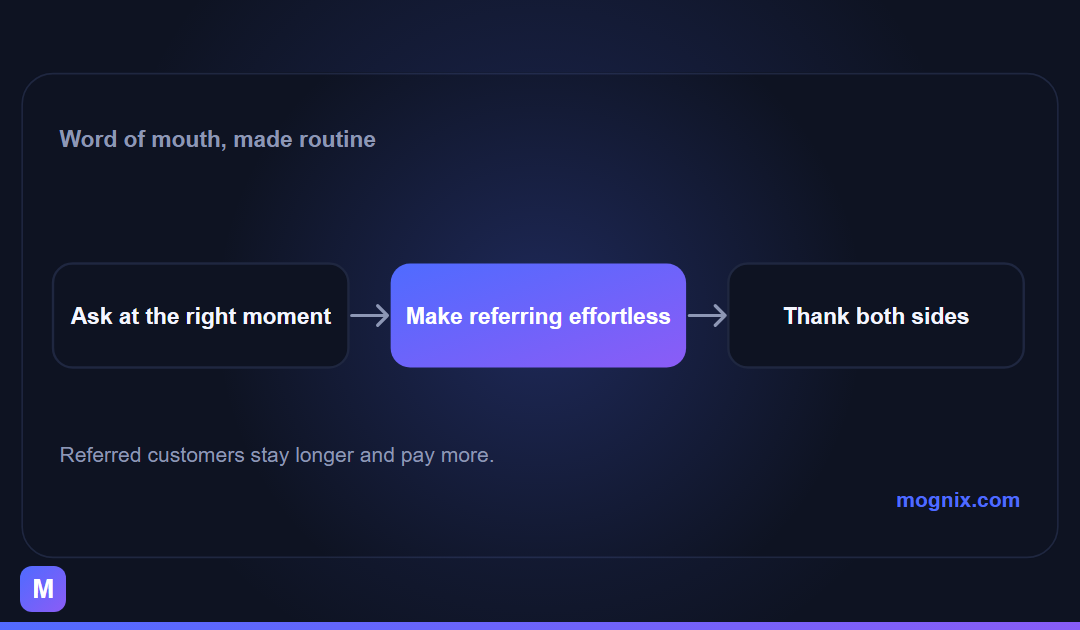
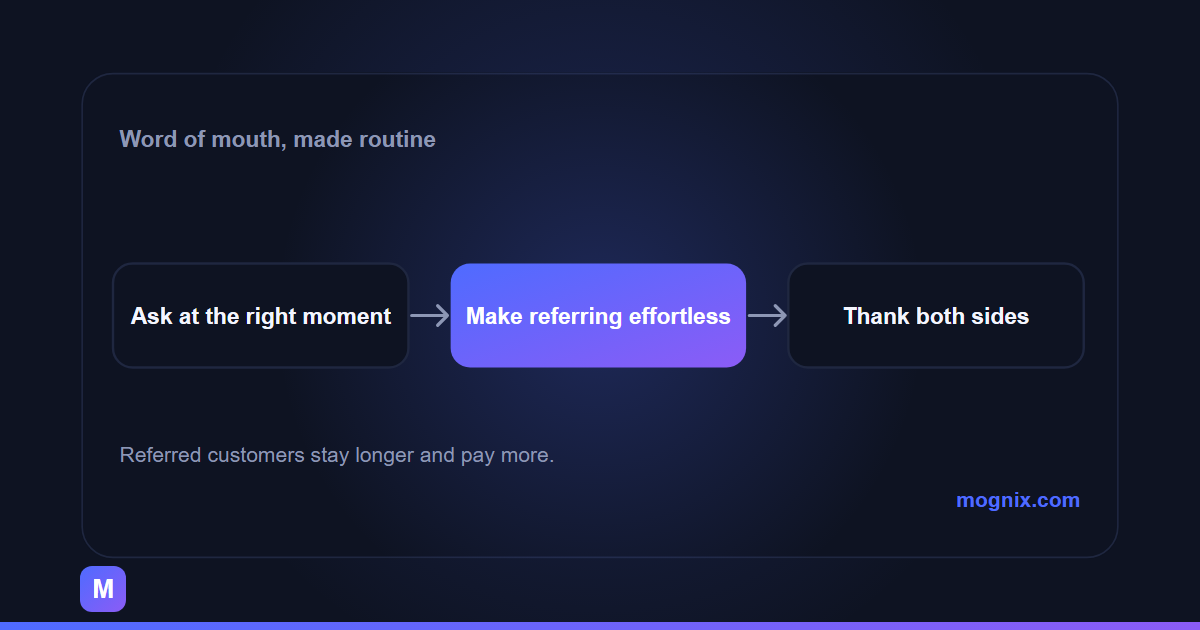
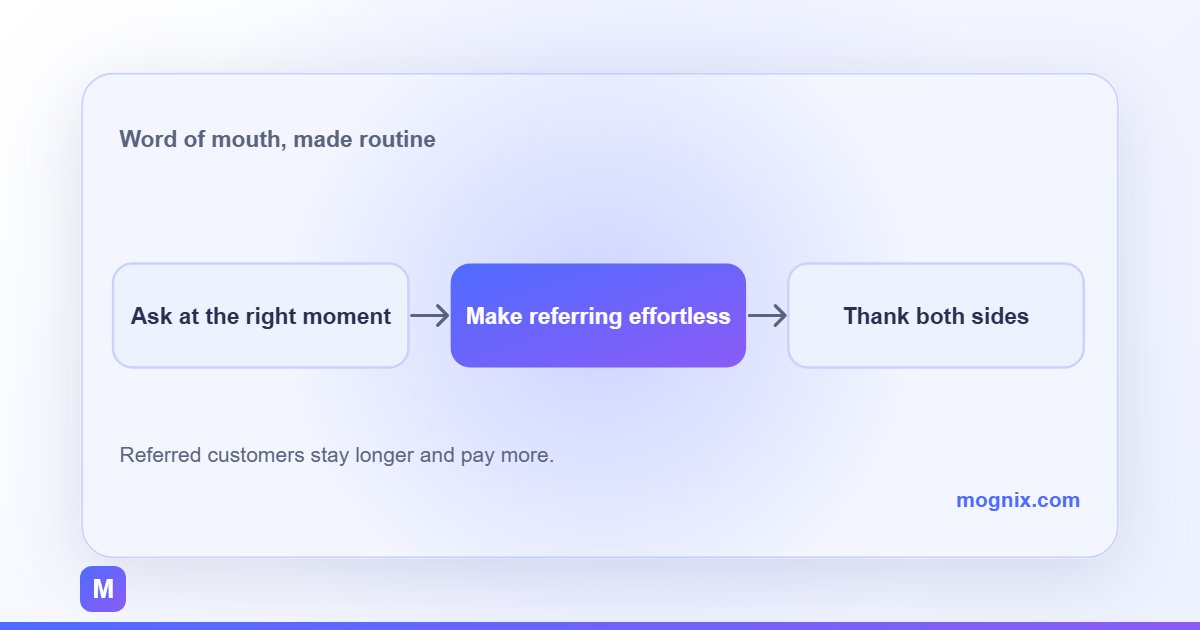
The sequence to run is short enough to do this month. List the customers with the three traits — past referrers, visible results, connected networks — and build the fifteen-name file. Write the one-line ask and the pre-written forwardable message; the message should contain the service, the price band and the contact, in three sentences. Ask the next ten customers at handover, then ask the same ten again at the review request. Record where each new job came from, with the referrer’s name, in the one place jobs are recorded. Identify three possible partner businesses and send each one an introduction of your own before asking for anything.
The result after a quarter is usually not dramatic, and it is measurable: a rising share of work arriving without advertising, at a lower cost per job, from customers who stay longer. That is the asset worth building, because unlike an ad account, it does not need funding to keep working. If the routine is worth handing to someone — because asking feels awkward or because nobody owns it — that is what an engagement covers, and the services overview shows where it sits alongside paid channels. If the budget is already tight, the way this fits around paid media is set out in the guide to marketing budgets for small businesses, and the message templates that keep the follow-up running without manual effort are in the note on email marketing for local businesses.