
Table of Contents
1. Why Google Reviews for Local Business Decide the Map Pack 2. Ask at the Right Moment 3. Make Leaving a Review Easy 4. What to Do With a Bad Review 5. Keeping Reviews Coming Without Nagging 6. Reviews on Other Platforms 7. The Routine, Written Down


Why Google Reviews for Local Business Decide the Map Pack
Google reviews for local business are one of the few ranking inputs a business can still move directly. You cannot buy them, you cannot hurry them, and no plugin can accumulate them for you — but you can ask for them reliably and answer them properly, and that is most of the work.
The reason they matter is the shape of local results. When someone searches for a service near them, Google shows three map results above the ordinary links. Those three positions take most of the calls, and Google picks them mostly on relevance, distance and prominence. The first two you set once — your categories, your service area, your address. Prominence is the one that keeps moving, and it is driven by reviews far more than by anything else in your control: how many, how recent, how often they mention the service you are trying to be found for, and whether you respond.
That makes reviews an operating routine rather than a marketing campaign. The businesses that lead their local results are rarely doing anything clever. They ask every customer, they answer every review, and they have been doing it for two years. Everything below is how to build that routine without annoying your customers or spending your week on it.
Ask at the Right Moment
The moment the job is finished
The best time to ask is the minute a customer is most pleased — usually right after the problem is solved, before the invoice is discussed at length and long before the novelty wears off. For a repair or a service visit that is at handover. For a project it is the day the work is signed off, not two weeks later when the excitement has faded.
Wait until the work is paid for, and never ask while something is still unresolved. A review request that arrives mid-complaint turns one unhappy customer into a public one.
Decide who sends the ask
Repeat requests only work when someone owns them. In a small business the owner or the person who finished the job should send it, from a named phone or email, not from a generic company address. A message from “Ramesh, who serviced your AC yesterday” is read; one from “Thank you for choosing us” is filtered out with the receipts.
If you already run follow-up messages, add the request as a step in that sequence rather than inventing a new channel — email marketing for local businesses is essentially the same skill of sending one small, timed message that a person will actually open.
Make it a step, not a favour
The reason most businesses get few reviews is that asking feels like begging. Fix that by making it a process step with a fixed script, done the same way for every completed job. The moment it becomes a routine, the awkwardness disappears and the volume becomes predictable.
Choose a channel the customer actually uses
For a local service, a WhatsApp message with the link lands far better than an email, and much better than a printed request tucked into an invoice. Match the channel to how that customer already talks to you.
Make Leaving a Review Easy
The short link
Every step between the customer and the review box costs you reviews. Get the short review link from your Business Profile and shorten it, so the message contains a tappable link that opens the review form directly rather than a page of instructions. If they have to search for your business name and pick between two similarly named shops, most of them will stop there.
What the request should say
Three lines is the whole message. Name the person, name the job, and give the link. “Thanks for having us out yesterday, Ramesh. If the wiring has been behaving, a quick Google review helps other people in the area find us: [link].” No essay, no plea, no “it would mean the world to us”.
Never write the review for them, and never send a draft to copy. Asking for honest feedback is legitimate; prompting the wording is not, and it also produces reviews that all sound identical, which helps nobody.
Remove the friction on your side
Claim and complete your Business Profile before you ask for anything — unverified listings lose the review link and most of the display. The completion checklist in our Google Business Profile optimization guide covers the pieces that make a profile look credible the moment somebody clicks through to review you.
Never offer anything in exchange
A discount, a raffle entry or a free service in return for a review is against Google’s policies and can get the reviews — or the listing — removed. It also poisons the signal: reviewers who were paid in attention write about the offer, not the work. The same rule applies to buying reviews. The coupon you save is never worth the risk to the profile that carries your phone number.
Google’s own notes on how local ranking works are worth reading before you redesign your request, because the line between asking and incentivising is drawn more sharply than most businesses assume — and a request that nudges customers toward particular wording sits on the wrong side of it.
What to Do With a Bad Review
Reply in public, resolve in private
A negative review is read far more carefully than a positive one, and the reply is what people are actually judging. Answer within a day, name the problem in their words, say what you are doing about it, and offer to continue away from the public thread. “I am sorry the fitting leaked this morning. That is not how we finish a job — I have asked our engineer to call you today and we will make it right” does more for a business than ten five-star reviews, because it shows a reader how you behave when something goes wrong.
Do not argue, do not contradict the customer in public, and do not include details that identify them.
When a review breaks the rules
If the review is from someone who was never a customer, is clearly spam, or contains abusive content, you can flag it. Google removes a minority of flagged reviews and the process is slow, so do not build your plan around removal — reply once, calmly, noting that you have no record of that customer, and leave it. Prospective customers can tell the difference between a real complaint and a fake one.
Reviews you should not answer at length
A one-star review with no text, or one written in a language your staff do not speak, deserves a short, standard reply rather than a paragraph. The goal is to show presence, not to win.
Keep a private record
Note every complaint, what caused it and what changed as a result. Two complaints about the same thing is an operational problem, not a reputation problem, and the fix belongs in your process rather than in your replies.
Keeping Reviews Coming Without Nagging
One reminder, not five
If you get no response, send one reminder about five days later and then stop. Repeated requests damage the relationship far more than the missing review damages your profile, and a customer who feels chased will sometimes leave the negative review they were not going to write.
Watch the trend, not the total
The number that matters is how many reviews you received in the last ninety days — that is what Google and readers treat as current. A business with two hundred reviews and six this year looks less active than one with forty and thirty of them recent. Note the quarterly count, and treat a month with none as a process failure worth investigating rather than a slow period.
Spread the asks across the channels you already use
The same ask can live in four places without being repeated to the same person: the message after a job, the bottom of a receipt, a card handed over at handover, and a follow-up email a week later. Most customers will only ever see one of them, so the repetition is invisible from the inside.
Answer the positive ones too
Responding only to complaints tells a reader that you engage when you have to. A one-line reply to a good review — thanking them by name and mentioning the job — is cheap, and it gives you a natural place to repeat the service you want to be found for.
Reviews on Other Platforms
Google is usually not the only place people check. Facebook recommendations, industry directories and local marketplaces all surface in searches, and a business with four hundred Google reviews and nothing anywhere else looks unmanaged. Keep one or two secondary profiles accurate — the same name, address and phone number — and let good reviews accumulate there too, since a link from those profiles back to your site is also worth having, which is part of how local link building works in practice.
What you should not do is spread thin. Three profiles that match your Google listing exactly are worth more than a dozen half-filled ones with inconsistent opening hours.
The Routine, Written Down
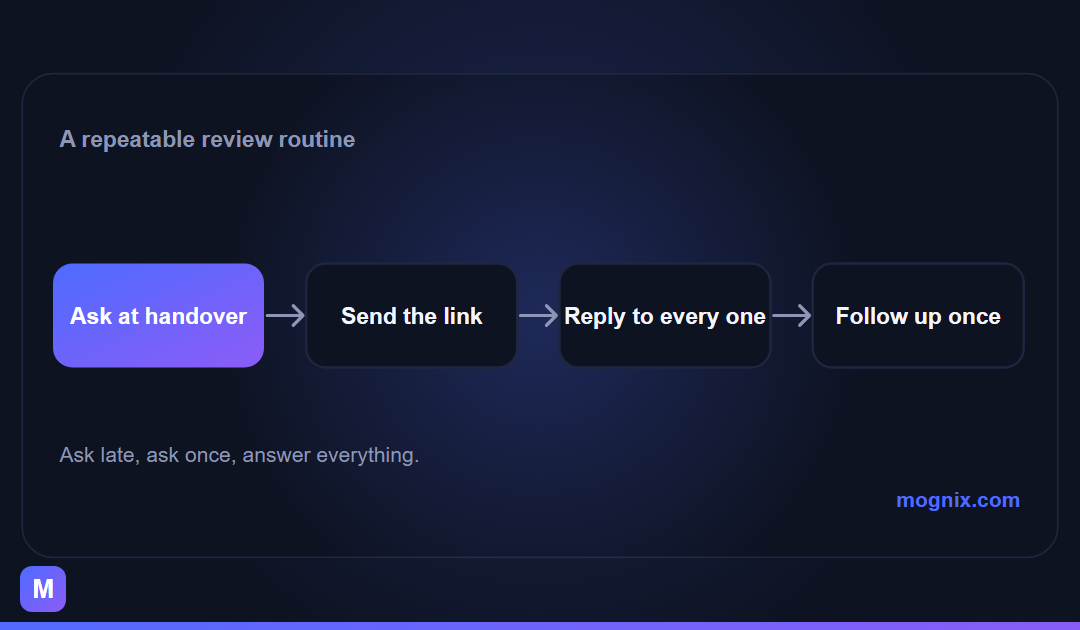
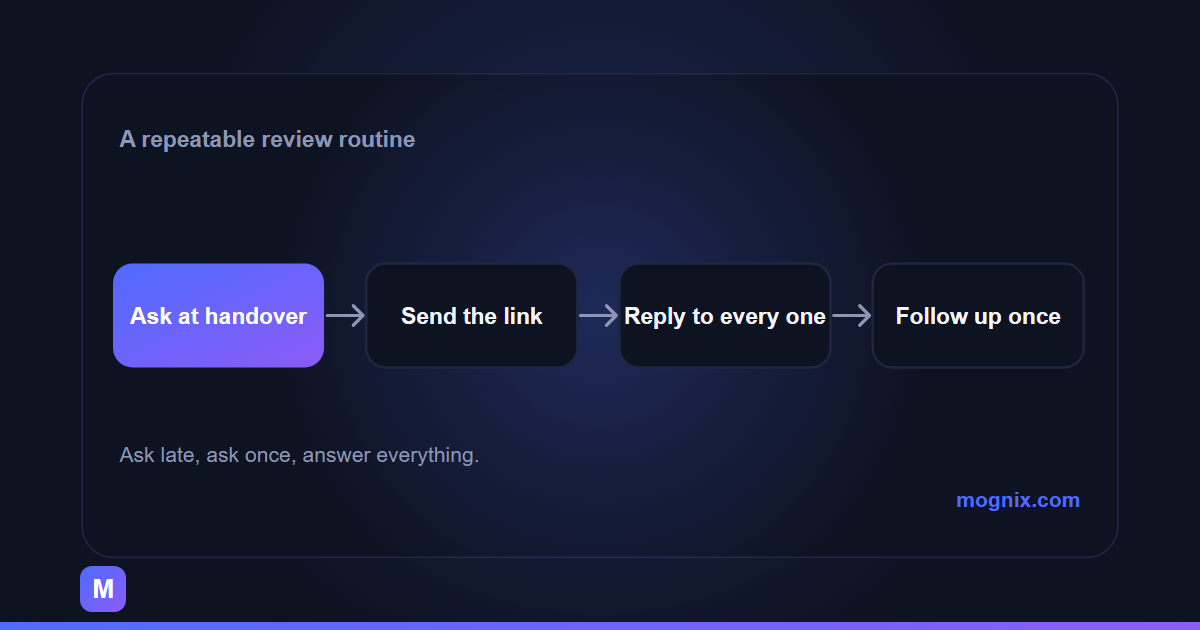
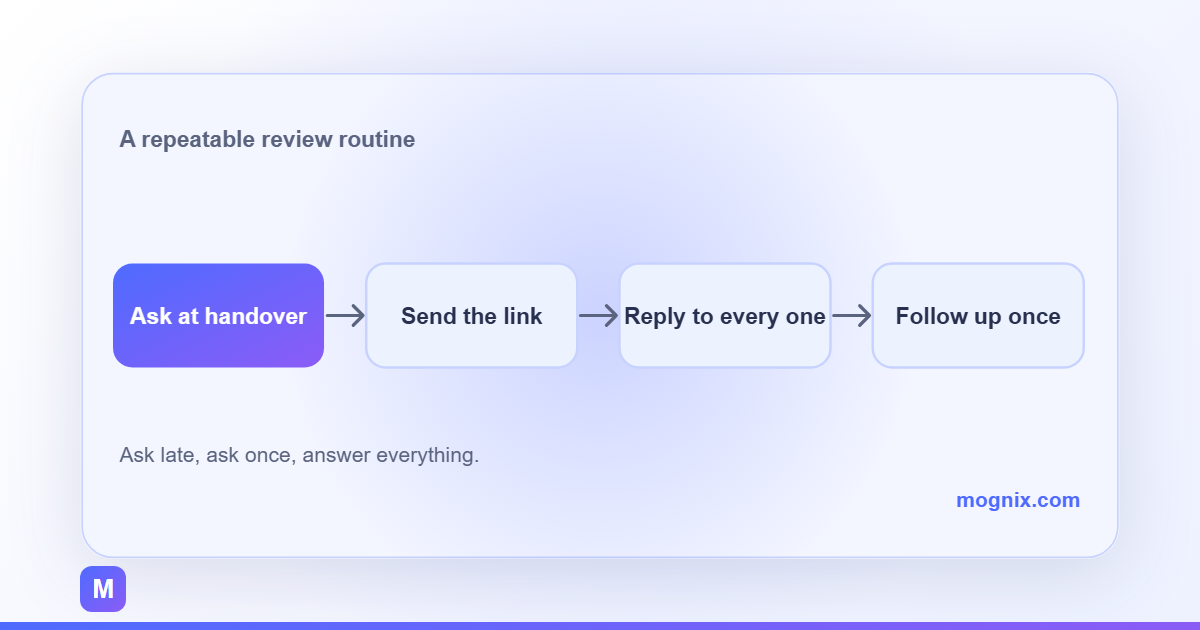
The whole system fits on a single page. After every completed job: one message, from a named person, with the short review link. Five days later if there is no response: one reminder, then stop. Every review, positive or negative: one reply, within a day. Every month: count the new reviews and read the search terms that brought people in. Every quarter: check the profile’s categories and services still match what customers actually ask for.
That is the difference between a business that is occasionally reviewed and one that leads its local results. Nothing about it requires expertise — only that it happens every week, by somebody whose job it is.
Review volume works alongside the technical side of local search rather than replacing it. Our SEO services cover both, and if you want a second opinion on where your local visibility is actually leaking, send us the profile and the site and we will tell you what we would fix first.