
Table of Contents
1. What a Marketing Budget for Small Business Starts From 2. Split the Budget Into Three Jobs 3. Give Every Channel a Number and a Job 4. A Monthly Rhythm: Cut, Hold, Scale 5. A Filled-In Example 6. When to Stop Spending


What a Marketing Budget for Small Business Starts From
A marketing budget for small business is usually set one of two ways: as a percentage of turnover that somebody once read in a report, or as whatever is left after everything else is paid. Both produce numbers that have nothing to do with your business, and both make it impossible to say whether the spending is working.
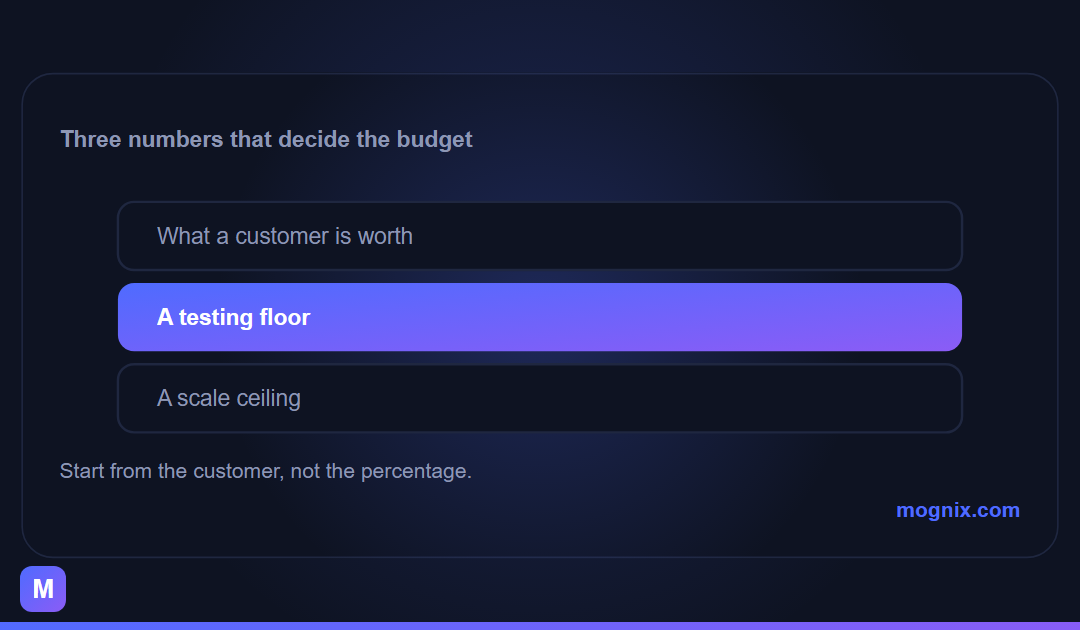
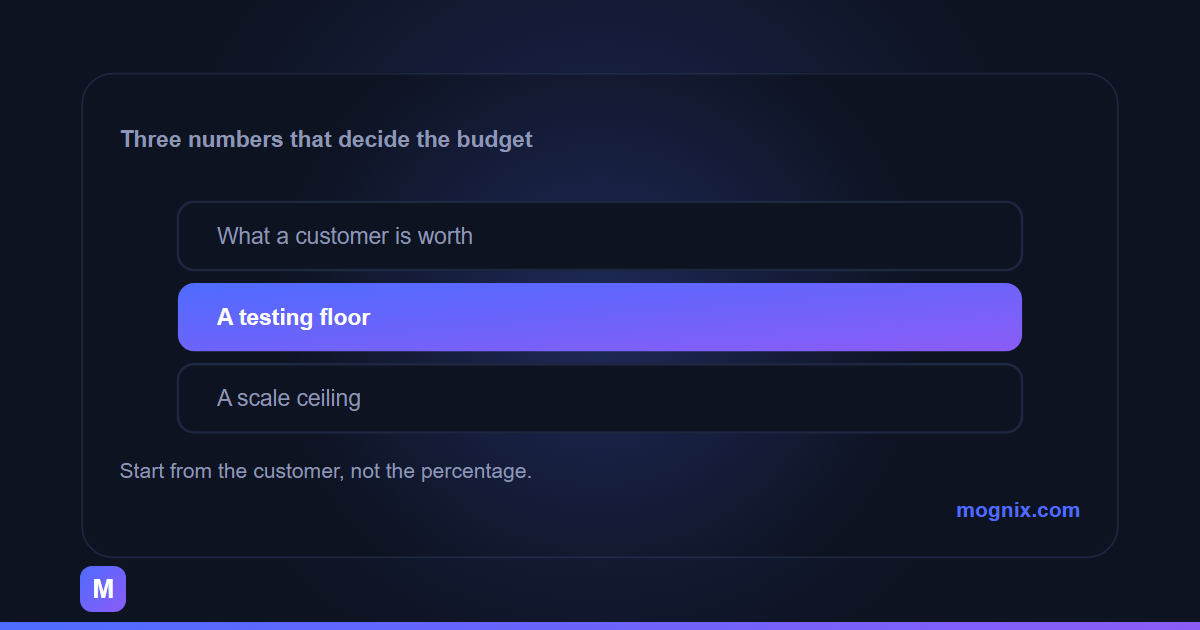
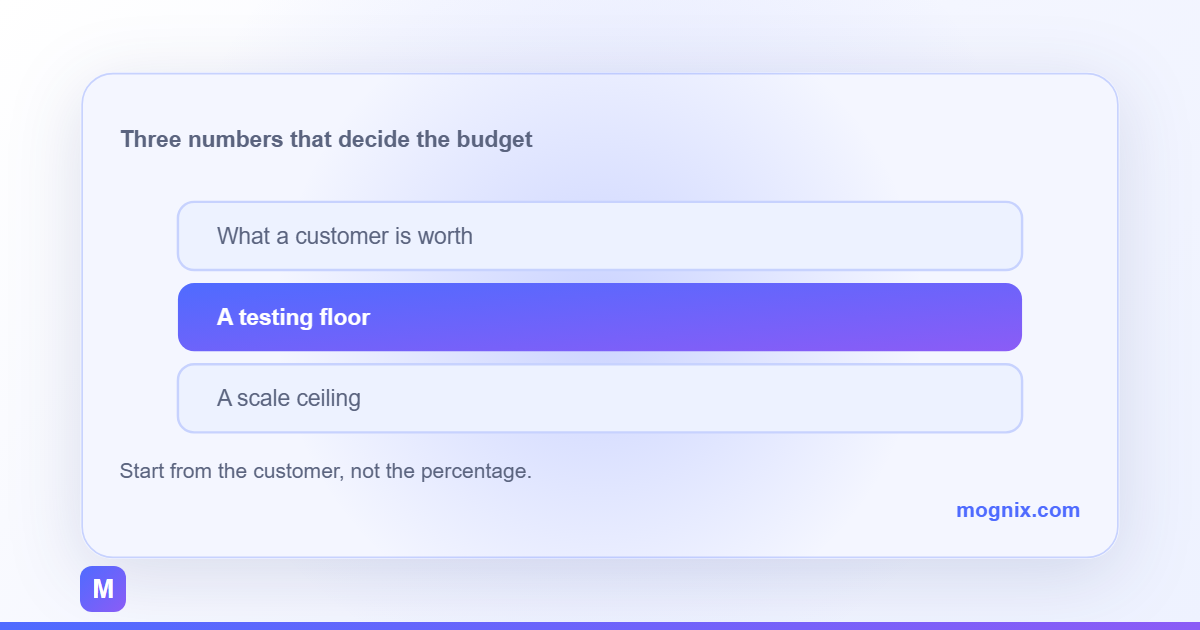
The version that holds up starts from a single question: what is one new customer worth to me? Answer that honestly and the rest of the budget becomes arithmetic. You can work out how much you can afford to pay for a lead, how many leads you need to hit your revenue plan, and which channels are capable of producing them at that price. Everything below builds that calculation and then turns it into a monthly routine.
Work out contribution, not revenue
The number that matters is what a customer leaves behind after the work is delivered. For a service business that is the average job value minus the materials, subcontractors and direct labour — contribution, not turnover. The difference is not academic. A ₹20,000 job at a 25% margin is worth ₹5,000; a ₹40,000 job at a 10% margin is worth ₹4,000. The bigger job is the worse customer to buy traffic for, and only a contribution calculation shows it.
Add the repeat and referral expectation
If a customer typically returns twice in three years, the lifetime contribution is roughly three times the first job, discounted for the fact that you have to keep them happy to earn it. Most local businesses can estimate this from their own records in an hour. Where a customer tends to refer one neighbour, count part of that too, but be modest — referrals are a bonus you cannot buy directly.
If you have never described your market or your ideal customer in writing, do that before the arithmetic. The market research guide from the US Small Business Administration is a free, practical starting point, and the questions it asks are the same whether you trade in Kolkata or anywhere else.
Set a maximum cost per lead
Now divide. Take the contribution from one customer and multiply it by your close rate to get the most a lead can cost you before the work becomes unprofitable. A business with ₹5,000 of contribution per customer and a one-in-four close rate can pay ₹1,250 per lead at break-even. A sane target is half of that, so the marketing still pays for the business rather than only for itself — ₹600 per lead in this example.
Treat that ceiling as a rule, not a suggestion
The ceiling is what stops a bad month from becoming a bad quarter. When a channel’s cost per lead crosses it, the channel gets fixed or paused; it does not get “one more month to see”. Whatever you do not spend on leads that cost too much is budget for the leads that cost the right amount.
Split the Budget Into Three Jobs
Bought attention: search and social
Paid channels bring strangers. Search ads capture demand that already exists — someone typing the problem into Google — and social ads create it by interrupting people who were not looking. They behave differently enough that advertising budget should be split by intent rather than split evenly, which is the difference we set out in SEO versus Google Ads. Emergency services should be heavier on search; considered purchases and visual products usually earn more from social.
Owned assets: the website and the list
Money spent on the website — speed, the enquiry form, the pages that answer common questions — is spent once and keeps working. A site that loads in four seconds will depress every rupee you spend on advertising, forever, until it is fixed. The same applies to the email and WhatsApp list: it is the only audience nobody can raise a price on.
Earned attention: reviews, referrals, links
Reviews, referral requests and local links cost time more than money, but they are the cheapest source of new enquiries a local business has. If your budget is small, this is where the hours should go before any paid channel is opened, because a business with thirty recent reviews closes advertising leads at a better rate than one with three.
Set a ratio and revise it quarterly
A workable starting shape for a small service business is roughly half of the marketing budget into paid channels, a quarter into the website and the list, and a quarter into reviews, referrals and content. The exact split matters much less than deciding it in advance and revisiting it on a schedule rather than on a feeling.
Give Every Channel a Number and a Job
One primary metric per channel
A channel with three metrics has none. Google Ads is judged on cost per enquiry against your ceiling. Social ads are judged on cost per lead and on whether those leads match the customer you actually want. The website is judged on the conversion rate of the pages people land on. Email is judged on how many messages get replies, not on opens.
Write the metric down next to the spend, and review them together. A channel that cannot name its metric is a channel you cannot defend.
The testing floor
Testing is a real cost, and pretending otherwise produces budgets that never leave the status quo. Give each new channel or campaign a floor — an amount you are willing to spend purely to learn, with no expectation of a return inside the first six weeks. For a local business, a floor of one to two months of a modest daily budget is usually right. Below that the platform never gathers enough data to optimise.
Cap the number of open tests
Every open test costs attention, and attention is the scarcest resource in a small marketing operation. One paid channel plus one improvement project is enough for most businesses. Two paid channels at once can work if both already have history; three new things at once guarantees that none of them gets read properly.
Account for time honestly
If you are doing the work yourself, your hours are part of the budget. A business that spends ₹15,000 a month on ads and ten hours a week managing them is spending far more than a business that spends ₹25,000 on ads with a partner doing the management. Count the hours at the rate you would pay someone, and decide deliberately whether you want to buy that time back.
A Monthly Rhythm: Cut, Hold, Scale
The three questions
Once a month, ask the same three questions of every line in the budget. Did it produce leads at or below the ceiling? Is the number reliable enough to act on — at least a handful of leads rather than one lucky week? And is there room to spend more without the cost rising? Those three answers classify each line as cut, hold or scale.
What to cut
Cut anything that has had a fair test and stayed above the ceiling: a channel with a cost per lead double the target, an audience that produced clicks and no enquiries, a page nobody converts on. Cut the spend, not the channel’s records — keep the numbers so you can see what you learned.
What to hold
Hold anything inside the ceiling whose volume is too small to judge, and anything seasonal that will come back. Holding is a decision, not a default; write down what would make you change it, and the date you will look again.
What to scale
Increase the budget on channels that are comfortably below the ceiling with room to spend. Raise by 20-30% at a time rather than doubling, because the cost per lead usually rises as you spend more, and a large jump can take a channel from efficient to expensive in a single month without telling you where the line was.
Keep one line for the boring work
Budget something every month for the unglamorous items: fixing a slow page, updating service pages, requesting reviews, renewing a listing. These rarely show up as a dramatic win in the reporting and they are usually what keeps the paid numbers viable.
A Filled-In Example
Here is the arithmetic for a service business with an average job of ₹25,000, direct costs of ₹15,000, contribution of ₹10,000, a close rate of one in four, and a plan to win eight new customers a month. Contribution per customer is ₹10,000, so the break-even cost per lead is ₹2,500 and the working target is half of that. Eight customers at one in four means thirty-two leads, which at ₹1,250 each is ₹40,000 of marketing spend for ₹80,000 of contribution — the work pays for twice what it costs.
Note what the example does not do. It does not start from a percentage of turnover, and it does not treat a 3:1 return on ad spend as the goal. It sets the maximum it can pay for a lead, then works out how many leads are needed, then lets the channels compete for the spend at that price. If the numbers do not add up at the operational level, no channel choice will fix it — a free marketing audit usually finds that the close rate, not the advertising, is the constraint.
Budgeting for a single paid channel follows the same logic with fewer variables. The shape of a realistic Meta ads budget is worked through separately if social is where you intend to start.
When to Stop Spending
There are three honest reasons to pause marketing rather than increase it. The first is capacity: if you cannot deliver another ten jobs this month, more leads will only damage your reviews and your reputation. The second is conversion: if enquiries arrive and nobody answers them within an hour, the money is being spent to generate calls your business is not picking up. The third is that the numbers you are optimising cannot be trusted — no reliable cost per lead means no way to tell a good month from a lucky one, and the first spend should go on tracking rather than on traffic.
None of those are a reason to stop permanently. They are a reason to fix one operational thing first, then reopen the budget with a number you believe.
Local businesses rarely lose money because they spent too little on marketing. They lose it by spending on channels whose numbers are never read, with no ceiling on what a lead may cost, and by cutting a channel the week before it would have started working. A written budget, three metrics and one review a month is enough to avoid all three.
Our strategy service starts with the numbers in this article — what a customer is worth, what a lead may cost and which channel is closest to that price. Share your current spend and results and we will tell you which line to cut first.