
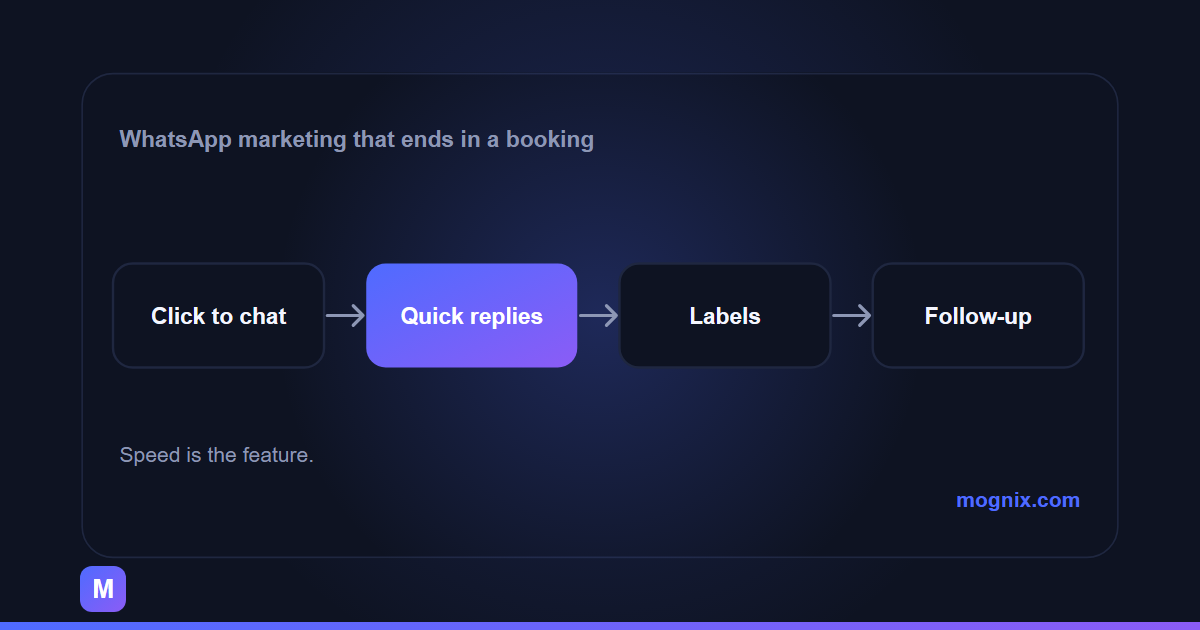
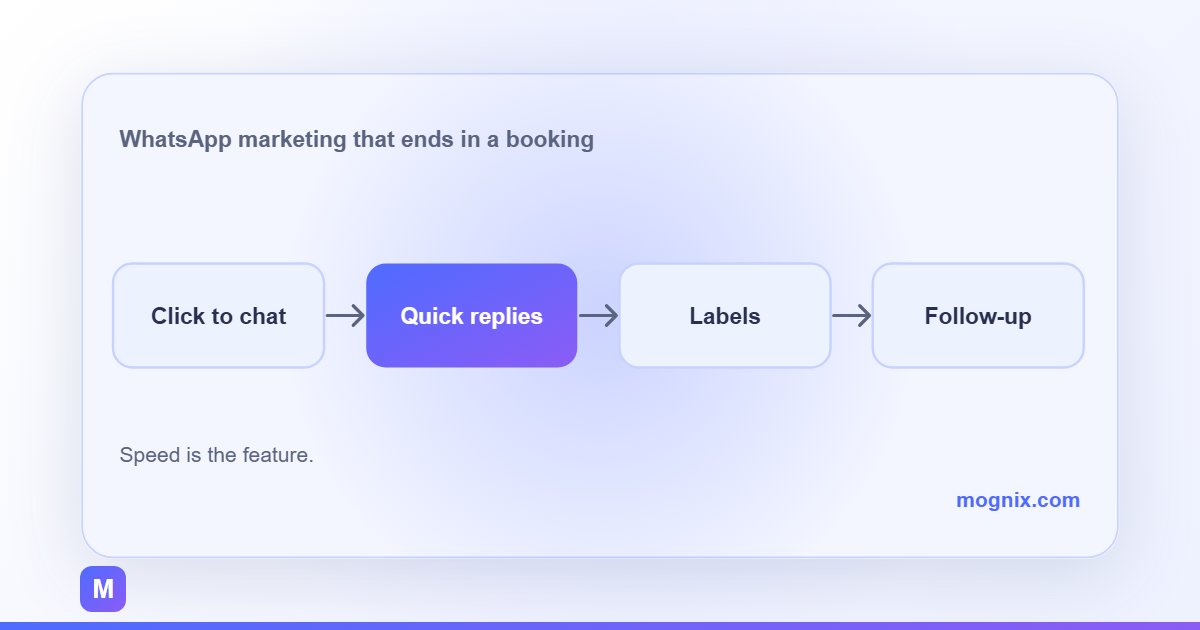
WhatsApp business marketing is not a broadcast channel for offers. For a local service business it is closer to a reception desk that fits in a pocket: the customer asks a question, expects an answer quickly, and decides whether to book based on how that exchange feels. The marketing work is making the first reply fast, the information accurate, and the follow-up happen without anyone remembering to do it.


That framing matters because most WhatsApp advice is about bulk messaging and catalogues. Both have a place, but neither fixes a business that takes six hours to reply. The platform rewards responsiveness, and the customer compares it with every other business that answered in five minutes.
Make the first message easy to send
The click-to-chat link is the most important piece of WhatsApp marketing infrastructure. It opens a conversation with a pre-filled message, which removes the blank-screen problem and tells the business what the customer wants before the first reply.
Put the link where the intent is
The link belongs on the service page next to the phone number, on the contact page, in the Google Business Profile, and in the Instagram bio. Each placement should use a message that names the service: “Hi, I would like a quote for AC repair.” A generic “Hi” forces a second exchange before anything useful happens.
Use the official wa.me format with the country code and no punctuation in the number. Test it on a phone that is not the business phone; a link that opens the wrong number is worse than no link.
Set the profile up like a shopfront
The WhatsApp Business app profile carries the name, logo, description, address, hours and website. Fill all of it in, and make the description say what the business does and where, in the same words as the website. The catalogue can hold services with prices or “from” ranges; even a short catalogue saves the first three messages of every conversation.
The away message is not optional. If the business closes at six, the away reply should say when it reopens and what to do in an emergency. Silence overnight reads as disinterest by morning.
Reply fast, then qualify
The first reply decides the conversation. A person who messages three plumbers and gets one answer in four minutes books that one. Speed is not a growth hack; it is the product.
Use quick replies for the first three questions
Most first messages ask one of three things: price, availability, or whether the business covers the area. Write a quick reply for each, with a placeholder for the detail that changes. The reply should answer the question and ask the one question needed to move forward, not dump a paragraph of terms.
For example: “Thanks for messaging. A standard visit is ₹X, and the price is confirmed before work starts. Which area are you in?” That is specific, sets the next step, and is short enough to read on a phone.
Qualify without interrogating
The details needed to quote are usually the service, the location, the timing and a photo. Ask for them in that order, one message at a time. A list of eight questions in the first reply feels like a form and gets abandoned.
Labels are the lightweight CRM. Create labels for “new enquiry”, “quoted”, “booked”, “follow up” and “not a fit”, and apply one to every conversation. Then the business can see how many enquiries are waiting without scrolling through chats.
Hand over to a human at the right moment
Automation is fine for the first reply and the basic questions. It is not fine for a complaint, a complex job or a negotiation. The handover should be explicit: “I am passing this to the service team, they will reply within the hour.” A customer who knows a person is coming waits; one who suspects a bot leaves.
Follow up without becoming spam
Most enquiries do not become jobs on the first message. The customer is comparing, waiting for a spouse to agree, or has not checked their schedule. A follow-up is a service, not a nuisance, if it is timely and specific.
Two follow-ups, then stop
The first follow-up goes out the next working day: “Just checking whether you had any questions about the quote.” The second goes out three days later, with something useful: a photo of similar work, a link to the warranty, or a note that the slot is still open. After that, stop. A third unanswered message damages the brand more than it recovers a job.
Use the “follow up” label and a scheduled reminder, not memory. The WhatsApp Business app supports quick replies and labels; larger teams use the API with a shared inbox, which also lets several people answer one number.
Keep the message personal and short
Do not send a template that begins “Dear customer”. Use the name if it is known, refer to the service they asked about, and keep it under three lines. The follow-up should feel like the same person continuing the conversation.
Broadcast lists and status updates can work for reminders, seasonal maintenance and offers, but only to people who have opted in. A broadcast to every number that ever messaged is the fastest way to get blocked and reported.
Measure WhatsApp business marketing like a channel
WhatsApp enquiries are easy to feel and hard to count. Add a simple source field to the booking record: WhatsApp, phone, form, walk-in. Then compare the conversion rate and average job value by source, not just the number of messages.
The metrics worth tracking monthly are the number of new conversations, the median time to first reply, the share that become quotes, and the share that become jobs. The first reply time is the one to fix first; it moves the others.
Also track response quality. A fast reply that quotes the wrong service creates a second problem. Read ten conversations a month and check whether the first message answered the actual question.
Where WhatsApp fits in the wider funnel
WhatsApp does not replace the website; it shortens the path from a visitor to a conversation. The ad or search result creates the intent, the page confirms the service and the WhatsApp link removes the friction of a form. For a business that answers quickly, that combination often beats a landing page with a five-field form.
It also changes the content plan. The questions that arrive in WhatsApp are the questions the site should answer, and the answers that work in chat are the ones to turn into quick replies and FAQ sections. The channel and the website improve each other when they are treated as one conversation.
Our Meta Ads services build the click-to-chat campaigns, and the guide to Meta ads in Kolkata covers the audience and budget side. If the messages arrive but the bookings do not, request a free audit and we will read the first ten conversations with you.